
Trump empties out election commission leadership just months before midterms
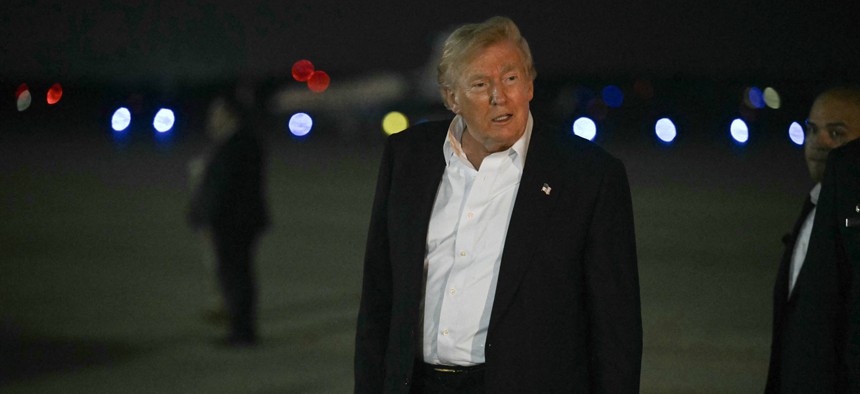
President Donald Trump walks toward his motorcade after he arrived at Joint Base Andrews, Maryland on July 9, 2026. SAUL LOEB / AFP via Getty Images





The shake-up raises questions about voting system certification, federal election security coordination, and the commission’s ability to approve key policy decisions.
President Donald Trump removed the remaining members of the U.S. Election Assistance Commission on Thursday, leaving the independent agency without any sitting commissioners just months before the 2026 midterm elections, according to a White House official.
“The President, and head of the Executive Branch, reserves the right to remove individuals that may not be totally aligned with the important task of securing America’s elections and ensuring every legal vote is counted,” the official said in a statement to Nextgov/FCW. “The Slaughter decision gives the President precedence to do so.”
Democratic commissioners Benjamin Hovland and Thomas Hicks were fired, while remaining Republican commissioner Christy McCormick resigned. VoteBeat first reported the dismissals.
The changes leave the commission, which helps oversee federal voting system certification and election administration programs, without the bipartisan leadership responsible for approving some of its most consequential decisions.
The EAC is perhaps best known as a clearinghouse for administering federal election grants and certifying voting systems under the nation’s voluntary voting system guidelines. While those standards are not mandatory, they have become the benchmark many states rely on when purchasing, testing and deploying election technology.
Although the Cybersecurity and Infrastructure Security Agency serves as the federal government’s lead agency for protecting election infrastructure from cyber threats, the EAC has become an important partner in the broader election security and election education ecosystem. The commission works with CISA, state election officials and voting system manufacturers on issues like system testing, certification, security guidance and information-sharing.
“The Administration from the start has been working across all agencies and local partners to safeguard elections from fraud and abuse, and investing in a strong infrastructure to sustain that mission especially in the midterm elections,” the White House official said.
The removals could raise questions about how the agency will carry out some of its statutory responsibilities as federal officials, states and voting system vendors prepare for this year’s midterm elections.
Career staff can continue many of the agency’s day-to-day operations. Still, the absence of commissioners would complicate actions that require a formal vote or approval, potentially slowing decisions involving voting system standards, certifications and other matters.
The White House official did not offer a specific reason for Trump’s action. But the commission has previously declined to change the national voter registration form to require applicants to provide documentary proof of U.S. citizenship, a step Trump called for in a sweeping March 2025 executive order on U.S. elections.
A federal judge later blocked that portion of the order, ruling that it exceeded the president’s authority because the Constitution gives Congress and the states primary responsibility over election administration and oversight. The administration has said it plans to appeal.
The dispute underscored the limits of the White House’s authority over an agency Congress created as an independent, bipartisan commission following disputes during the 2000 presidential election. Under rules set by the 2002 Help America Vote Act, the EAC is led by four commissioners, with no more than two members from the same political party.
It’s unclear when the administration plans to nominate replacements or how long the commission could operate without sitting members. Any new commissioners would require Senate confirmation.
The leadership vacuum comes as election officials continue preparing for the 2026 midterms while confronting cyber threats, foreign influence operations and persistent efforts to undermine public confidence in the security of U.S. elections.
The removals are an “extraordinary step that demands an immediate explanation from the administration and raises profound concerns about political interference in the institutions that support our elections,” said Sen. Mark Warner, D-Va., who serves as vice chairman of the Senate Intelligence Committee.