
Tech bills of the week: quantum computing research; AI workforce development; and more
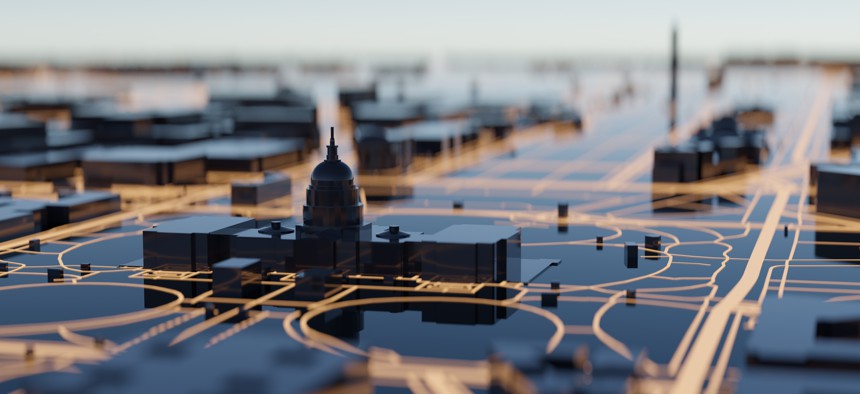
Jarmo Piironen/Getty Images


Lawmakers introduced measures this week to criminalize AI-generated impersonation, modernize NOAA’s weather radio system and create a nationwide network of cloud-enabled laboratories.
Enhancing quantum computing research
Rep. Randy Feenstra, R-Iowa, introduced a bill on Monday to amend the National Quantum Initiative Act of 2018 to include stronger provisions for quantum modeling and simulation.
Quantum modeling and simulation involves programming computers to mimic what a fault-tolerant quantum system could do. As a real fault-tolerant, cryptographically-relevant quantum computer is still in development, simulation and modeling systems offer insight into the applications of a quantum computer that can sufficiently process a large number of qubits.
“This legislation would ensure quantum molecular simulations and modeling are included in the National Quantum Initiative,” a press release from Feenstra’s office said. “Quantum molecular simulations and modeling will enable scientists to study chemical elements and reactions with unprecedented precision. By harnessing the power of quantum computing, researchers can better understand molecular behavior, including nitrogen fixation, a key process in producing fertilizer for our agriculture industry.”
Expanding AI education and career development opportunities
Sens. Jerry Moran, R-Kan., and Maria Cantwell, D-Wash., introduced a bill on Wednesday to improve education and workforce development for emerging technologies — specifically artificial intelligence and quantum computing — via expanded National Science Foundation programming.
The NSF AI Education Act would expand scholastic programs to support a domestic workforce fluent in AI and other technologies. Diverse academic institutions, including minority-serving institutions, non-profits, traditional schools and emerging research centers are all eligible to apply for the grant awards the bill proposes.
In addition to NSF, the Agriculture Department would also play a pivotal role in the grant administration process. The bill stipulates that a focal point for research is the integration of AI into modern agriculture practices, as well as in advanced manufacturing.
The bill also draws upon existing provisions in the CHIPS and Science Act, establishing a minimum of five Centers of AI Excellence across community colleges and vocational schools nationwide. The Regional Technology and Innovation Hub Program, created by the CHIPS Act, would serve as a coordination partner.
“The future of our state depends on a strong workforce that is equipped with the tools needed to meet tomorrow’s challenges,” Moran said in a press release. “Through investments in STEM education, fellowships and hands-on-learning from kindergarten to college, this legislation takes an all-of-the-above approach that will provide critical opportunities to students from all across the country.”
Modernizing and streamlining federal loan programs
A bipartisan group of House and Senate lawmakers introduced legislation on Wednesday to create a new platform, known as Lending.gov, “to provide a single source of access to loans provided by Federal agencies.”
The proposal — sponsored by Sens. Marsha Blackburn, R-Tenn., and Maggie Hassan, D-N.H., and Reps. Brad Finstad, R-Minn., and Raja Krishnamoorthi, D-Ill. — would combine access to disparate federal loan programs into one digital site, which the lawmakers said would also help to reduce fraud across federal lending initiatives. In a press release, the bill’s backers said there are currently more than 175 federal loan programs operating on outdated systems.
“Our legislation establishes Lending.gov as a single, secure, modern platform that will streamline operations, strengthen fraud detection, and ensure assistance reaches Americans who qualify without unnecessary delays,” Krishnamoorthi said in a statement. “By consolidating these systems, we can save at least $2 billion annually while delivering faster, more accountable service.”
Creating a nationwide network of cloud laboratories
Rep. Jay Obernolte, D-Calif., introduced a bill that would task the director of the National Science Foundation to execute a cloud lab network program. The proposal is co-sponsored by Reps. Ro Khanna, D-Calif., Rich McCormick, R-Ga., and Jake Auchincloss, D-Mass.
The Cloud Labs to Advance Biotechnology Act of 2026 would create the Cloud Laboratory Network Pilot Program within NSF — along with support from leadership at the Energy Department — to coordinate cloud laboratories independently operated by private industry, government labs and academia.
The cloud laboratory program will focus on biotechnology research endeavors, especially collecting and analyzing biological data to train AI models.
“Artificial intelligence is only as strong as the data it is trained on,” Obernolte said in a statement. “To keep the United States the leader in AI-driven biotechnology, we must invest in the infrastructure that empowers our scientists. The Cloud LAB Act will help ensure America remains at the forefront of innovation while incorporating strong safeguards for security and responsible research.”
Examining how to integrate AI into U.S. telecoms
Obernolte also teamed up with Rep. Jennifer McClellan, D-Va., to introduce the AI-Ready Networks Act. The bill would direct the National Telecommunications and Information Administration to produce a report on the integration of AI systems into U.S. telecommunications networks.
The mandated report would be due within 18 months and include analysis of AI’s benefit to telecommunications infrastructure, evaluation of current best practices and relevant laws and recommendations on amending the Communications Act of 1934 to include AI.
“AI’s impacts on our workforce and technological landscape cannot be overstated, and we must act now to ensure these changes both strengthen our telecommunications ecosystem and benefit the American people,” said McClellan. “This bipartisan bill will ensure Congress has the information it needs to assess best practices for the use of AI, support innovation in telecommunications networks and improve transparency for the public.”
Criminalizing AI impersonation
A group of House and Senate lawmakers have moved to address artificial intelligence-driven impersonation by introducing a measure that would create new criminal penalties for individuals who pose as real or imaginary persons through the use of AI-generated or digitally manipulated audio or visual mediums.
The bipartisan bill — sponsored by Reps. Vern Buchanan, R-Fla., and Darren Soto, D-Fla., and Sens. Tim Sheehy, R-Mont., and Lisa Blunt Rochester, D-Del. — would create a new offense under the Communications Act to penalize digital impersonators, which could include “imprisonment, fines and forfeiture of proceeds, as well as civil enforcement under the Federal Trade Commission Act for unfair or deceptive acts or practices enforced by the Federal Trade Commission.”
Several companies and organizations, including Microsoft and AARP, have already voiced their support for the proposal.
“We are seeing a disturbing rise in AI-generated voice clones and deepfake videos that convincingly impersonate loved ones, business executives, government officials and trusted institutions to steal money,” Buchanan said in a statement. “Congress must act to stay ahead of these threats by modernizing federal law to keep up with emerging technology. The AI Fraud Accountability Act makes clear that if you use AI to defraud Americans, you will be prosecuted.”
Modernizing NOAA’s weather radio system
House Science, Space and Technology Committee Chairman Rep. Brian Babin, R-Texas, introduced a bill to modernize the National Oceanic and Atmospheric Administration’s weather radio system to support better communication during severe and hazardous weather events.
The NOAA Weather Radio Modernization Act would update the Weather Research and Forecasting Innovation Act of 2017 to improve nationwide coverage during severe weather events. The bill also stipulates expanding radio service broadcasts to rural and potentially vulnerable regions, such as communities without strong broadband access.
The measure looks to develop new avenues for communication, including satellite backup capabilities and commercial provider partnerships to ensure consistent radio service and coverage. A separate provision also asks the Under Secretary of Commerce for Oceans and Atmosphere to work with the General Services Administration on making leased land, transmitters, antennas and tower space available for expanded NOAA radio broadcasting.
“NOAA Weather Radio remains one of the most reliable ways to deliver lifesaving warnings when other systems fail,” Babin said in a press release. “When cell networks go down or internet service is unavailable, Americans still need a dependable way to receive emergency alerts. This bill strengthens that capability and helps ensure communities are not left without critical warnings during severe weather and other disasters.”
Support for AI research at HBCUs
Finally, Rep. Valerie Foushee, D-N.C., introduced a bill on Thursday to amend the National Artificial Intelligence Initiative Act of 2020 “to provide for a special allocation of certain awards of financial assistance to historically Black Colleges and Universities relating to national artificial intelligence research institutes.”