
Trump’s national security strategy risks blinding US to other threats, former officials warn
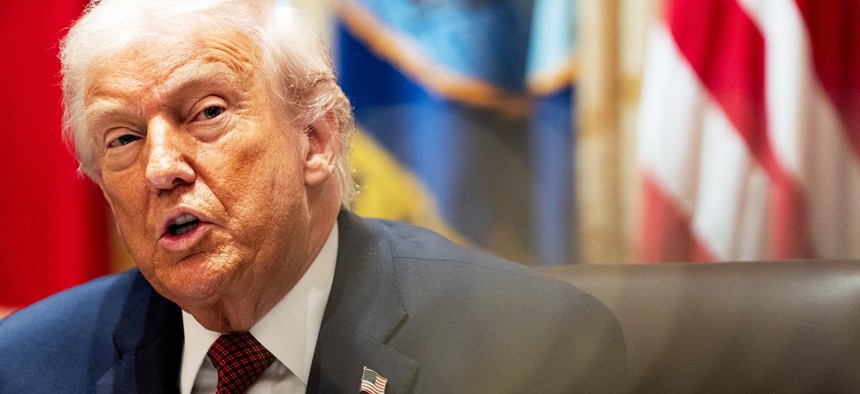
President Donald Trump participates in a roundtable discussion with farmers in the Cabinet Room of the White House on Monday December 8, 2025. Demetrius Freeman/The Washington Post via Getty Images



The White House’s push to prioritize Venezuela, coupled with hardline policies on migration and drug trafficking, threatens to pull intelligence resources away from enduring security challenges in Europe, Asia and beyond, they argue.
President Donald Trump’s new national security strategy appears to favor steering spying resources toward short‑term, transactional priorities and would blind the United States to other emerging threats as it reduces focus on other longstanding transnational issues, former national security officials said Tuesday.
They spoke on a panel hosted by The Steady State, a group of ex-U.S. security officials focused on democracy and rule of law.
The strategy, released last week, puts emphasis on the Western Hemisphere and aims to decouple security relations with Europe, demanding it take more responsibility for its own defensive posture and work with “patriotic European parties” in phrasing that aligns with Europe’s far-right politicians. It also tasks the U.S. intelligence community with monitoring global supply chains as it seeks to advance economic interests at home.
Reflecting the Western Hemisphere focus, the U.S. has poured spying resources toward Venezuela in recent months, seeking to curtail narcotics trafficking by bombing alleged Venezuela-linked drug boats and to potentially oust dictator Nicholás Maduro from power. The legally dubious boat strikes are being heavily scrutinized by Republicans and Democrats in Congress.
The heavily-concentrated strategy backs the depletion of resources from spy agencies’ core missions and risks “blinding” the United States, said Lauren Anderson, a former FBI executive who led the bureau’s Joint Terrorism Task Force.
There’s been “such a huge diversion of resources that those agencies can’t keep their eye on the ball,” she said. “We’re blinding ourselves because we’ve taken so many people out of play.”
“One of the things you need from the intelligence community is the stuff you’re not looking for,” added Robert Cekuta, the former U.S. Ambassador to Azerbaijan who served for four decades in the U.S. Foreign Service. “And I’m looking at this [strategy] right now — while we’re focusing on Venezuela, okay, what are the Iranians doing? What are the North Koreans doing? What are people we’re not even talking about doing?”
The strategy involves devotion of resources akin to running a business, said Steven Cash, a former Department of Homeland Security intelligence official who leads The Steady State.
“What is the return on investment? And that’s the way this administration has talked about tariffs. That's the way it’s talked about at least some of our quasi warfighting,” he said. “What will we get back? I think it is likely to be very material.”
A comprehensive Wall Street Journal report released late last month detailed extensive business dealmakings being lodged into Russia-Ukraine peace talks, a highly unusual dynamic that could forever reshape U.S. relations with the European Union.
Trump has long mistrusted U.S. intelligence agencies, accusing them of being weaponized against him, especially after his 2016 election when spy agencies comprehensively assessed that Russia had sought to help him win the presidency through online influence operations.
Federal workforce reduction efforts brought about in Trump 2.0 have targeted major security and intelligence units across the government, including agencies like the NSA and the Cybersecurity and Infrastructure Security Agency.
Meanwhile, officials continue to warn of major foreign adversaries’ cyberattacks on U.S. government agencies and businesses. Espionage risks involving military servicemembers and their families are also an ongoing issue.