
Senate confirms Josh Rudd to lead NSA and Cyber Command
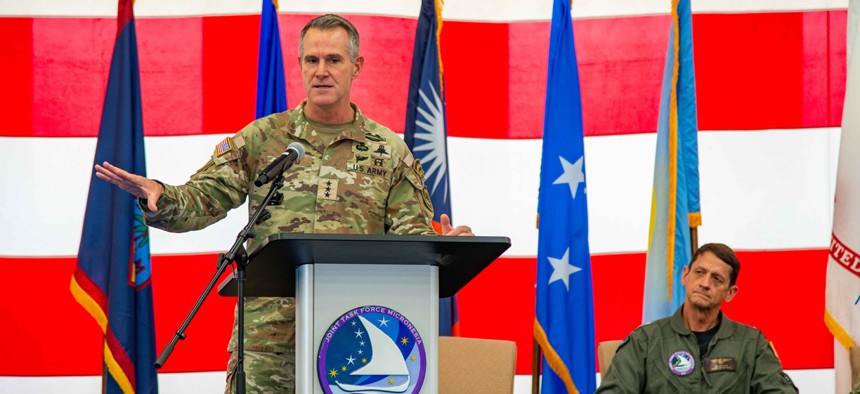
Lt. Gen. Joshua M. Rudd, then-deputy commander of U.S. Indo-Pacific Command, speaks during a change of command ceremony at Marine Corps Base Camp Blaz Fitness Center, May 15, 2025. The Senate confirmed Rudd to lead Cyber Command and the NSA March 10. Mass Communication Specialist 1st Class Samantha Jetzer/U.S. Navy






The foreign eavesdropping agency and digital combatant command have not had a permanent leader in place for the past 11 months.
The Senate on Tuesday confirmed President Donald Trump’s pick to lead Cyber Command and the National Security Agency in a dual-hatted capacity, giving the signals intelligence and hacking titans their first permanent leader in almost a year.
Gen. Joshua Rudd was confirmed in a 71-29 vote some three months after he was nominated to the position. NSA and Cyber Command have been without a permanent leader since far-right activist Laura Loomer pushed for the firing of the post’s previous occupant, Gen. Timothy Haugh, last April. Since then, Lt. Gen. William Hartman has led the agency in an acting capacity.
On Monday, the first procedural hurdle to Rudd’s confirmation cleared in a 68-28 vote. The nominee to lead Cyber Command and the NSA usually moves through the Senate without such a vote, but Senate Majority Leader John Thune, R-S.D., bypassed a hold from Sen. Ron Wyden, D-Ore., to confirm Rudd after Wyden pledged to block the nominee over concerns about his experience.
“The country needs an NSA director with experience in U.S. signals intelligence activities around the world. General Rudd does not have that experience,” Wyden’s written floor remarks said.
Rudd comes from a less traditional background than past military leaders who have led the two organizations. Up until now, he served as the number two leader of U.S. Indo-Pacific Command, and has spent his career largely in special operations and joint command roles. Some former officials and China analysts view Rudd’s Indo-Pacific background as relevant to U.S. cyber operations involving Beijing.
In his nomination hearings, he told senators that his experience consuming and acting on cyber intelligence qualifies him to serve in the position.
“I’m confident that the incredible talent at Cyber Com-NSA will provide great advice,” Rudd told the Senate Armed Services Committee in January. “I’m confident that, if confirmed, I can continue to lead and enable those two organizations to provide the best support to our combat commanders in the joint force, writ large.”
As director, he’ll be the face of some of the nation’s most secretive electronic spying activities. In April, a powerful foreign spying tool used often by NSA, Section 702 of the Foreign Intelligence Surveillance Act, will expire unless renewed by lawmakers.
“What I’ve experienced in my career is that this provides the warfighter, the decision-maker, [with] the ability to have critical insight into threats that enables decision making,” Rudd told members of the Senate Intelligence Committee in a separate January hearing when asked about 702. He said he knows the law has “saved lives here in the homeland.”
The upcoming midterm elections are also top-of-mind for observers of the intelligence agency and digital combatant command. Both units have played a major role in protecting the nation from foreign interference attempts on election outcomes.
But over the last year, the Trump administration has closed or scaled down many agencies and offices that track election threats, including the Office of the Director of National Intelligence’s Foreign Malign Influence Center and the FBI’s Foreign Influence Task Force. Trump has long been a skeptic of the intelligence community, especially due to its prior assessments that concluded Russia sought to help him win the 2016 election.
“The electoral process is fundamental to our democratic values, and Americans writ large, and I’ve committed throughout my career to serve to defend and uphold those values,” Rudd told the Senate intelligence panel. “Any foreign threat to the electoral process should be viewed as a national security concern.”
He will also have to contend with declining morale inside NSA, as well as significant workforce cuts that were influenced by Trump 2.0 efforts to shed government bloat and spending waste.
“General Rudd is a war hero with a lifetime of service to our nation. He is the right choice to lead the protection of our nation from cyberattacks by Iran, Russia, and China,” Sen. Tom Cotton, R-Ark., who chairs the Senate Intelligence Committee, said in a statement after Rudd was confirmed.
Editor's note: This article has been updated to note that it is the Office of the Director of National Intelligence’s Foreign Malign Influence Center.