
How to find alien technology
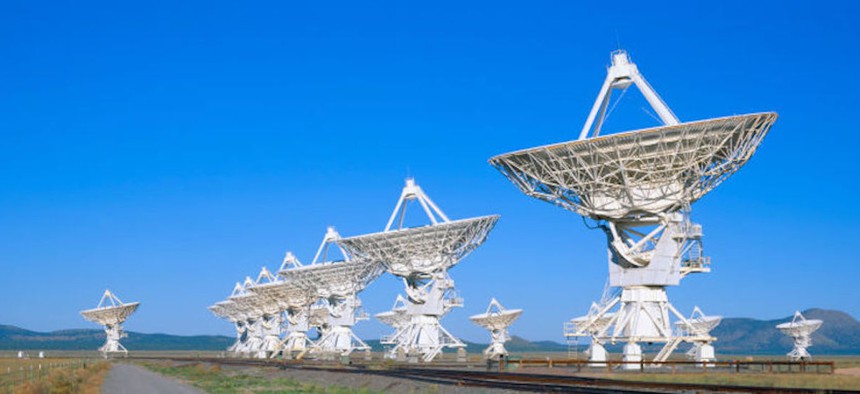
National Astronomy Observatory, Socorro, New Mexico. Joe Sohm/Visions of America / Contributor / Getty Images






I wanted to know how astronomers actually go looking for life in space.
You might think this column is about UFOs and the Pentagon's recent declassified files. It's not. We're talking about technosignatures, the evidence of alien technology: a radio or laser signal, artificial chemicals in a distant planet's atmosphere, or a Dyson sphere, a giant structure built around a star to capture its energy.
People mix the two up constantly, and astronomer Dr. Jason Wright sets the record straight. "The two fields have been really distinct, but in people's minds, they're heavily conflated," he says. Wright is a professor of astronomy and astrophysics, an expert in SETI, short for the Search for Extraterrestrial Intelligence, and he directs the Penn State Extraterrestrial Intelligence Center.
Here's the first thing he'll tell you: Forget the movies. In the movies, at the first inkling of alien life, the military shows up at the observatory, black SUVs, a general, a phone call to the White House. In real life, the press finds out before the government does, and then the signal everyone got excited about turns out to be a satellite, radio interference, or Earth talking to itself.
I wanted to know how you actually go looking for life in space — and Wright is the person for that. He has focused on technosignatures for the past eight years, but his CV runs 92 pages, most of it astrophysics, a good chunk of it coauthor credits. He tells me that most of the ways to hunt for alien technology date to the 1960s, and they all hinge on one thing: whether a civilization is doing something obvious enough to spot from light years away.
One approach is to image Earth-like planets around other stars and read their surfaces and atmospheres in reflected light, looking for chlorophyll or for methane and ozone, then arguing that only a biosphere can produce them together. That's the route NASA and the European Space Agency are taking to find non-intelligent life.
Or you build a large ground-based array and listen for radio waves. The universe is filled with radio emission from black holes, neutron stars, nebulas and the plasma between stars, Wright says. But transmissions from Earth's technology look different.
"They can only be produced by technology," Wright says. "There's no way you can mistake that for a natural process."
Right now, our radio transmitters are Earth's most obvious sign of life, and that method is likely easier than imaging a planet and detecting life on its surface. Some say radio is old-fashioned and that any advanced species moves to optical signals and laser light. Maybe, but radio still has big advantages and we still use it constantly.
"Starlink is all about radio waves," Wright says, so he doubts aliens would ever abandon it entirely. Either way, programs are scanning for optical signals from other stars, too.
Then there's the hardware. A civilization out to explore or settle the galaxy might build large numbers of probes and send them through interstellar space to other star systems, which means we should check our own solar system for anything orbiting the sun or the Earth. Those are called Bracewell probes, after Ron Bracewell, the Stanford radio astronomer who proposed them first.
Or you look for energy use. Burn through enough of your star's output and someone far away should be able to tell. Freeman Dyson proposed this in 1960 — a species using 10, 20, even 80% of its star's light would be impossible to miss.
The last method goes back to the planet search. While you're looking for chlorophyll or methane on planets around other stars, you might instead find chlorofluorocarbons in the atmosphere, or elemental silicon on the surface.
"Silicon doesn't appear in nature in its elemental form, but it does appear in solar panels," Wright says. "It very easily and almost trivially captures sunlight and turns it into useful energy." A planet covered in elemental silicon is a planet someone has covered in solar panels, he says.
Which one would turn up first depends on whom you ask. Ask 10 researchers and you'll get 10 answers, because the honest reply depends on guessing what an alien civilization would be ostentatious enough to do.
"These are all super subtle signals," Wright says. "We'll only see them if the scale of technologies is very big, like at least as much as ours, probably hundreds of times what we do."
Let’s say you found something tomorrow. What happens?
It probably doesn’t result in an immediate headline. Instead, people argue over it, evidence accumulates, and the scientific community comes around slowly.
"That process could take decades," Wright says.
Radio is different. Listeners might catch a narrowband signal that's hard to mistake for anything natural.
“The big issue is proving it didn't come from Earth," Wright says. That's what happened with blc1, a signal that seemed to come from Proxima Centauri, the closest star to our sun. The Guardian broke the leaked story in December 2020, and outlets worldwide ran with the alien angle. Nearly a year later, the team confirmed it was terrestrial interference.
"I know in the movies the military all shows up at the observatory, but that's not what happens," Wright says. "They don't pay any attention."
Today, there are protocols published by the International Academy of Astronautics. The rule is simple: Verify it before you tell everyone, and make sure other groups agree. Clear that bar and there's a process for informing the United Nations and the IAA through the proper channels.
And even then, the likeliest outcome is a worldwide shrug. Wright points to China's FAST telescope, the largest single-dish radio observatory on Earth, which flagged a handful of narrowband signals as possible technosignatures in June 2022. A state science paper ran the story, calling them possible "technological traces of extraterrestrial civilizations," then deleted it.
"What did not happen was that either the Chinese government or the U.S. government got nervous about it," Wright says. The Chinese astronomers went straight to their American collaborators at Berkeley and figured out what it was.
The other misconception is that 60 years of silence is a mystery. People reach for dramatic explanations: it's dangerous out there, there’s a reason the aliens are hiding or gone. Wright thinks that's backward.
"The most important work is actually just this systematic scanning of the sky, and we've done very little of it until very recently," he says.
So no black SUVs and no three-star general at the observatory door. If we ever do find intelligent life in the universe, it probably won't announce itself. It'll turn up how everything in this field does: slowly, and without ceremony.
NEXT STORY: NASA names 2,100 winners for SEWP VI