
When the storm hits: What Hurricane Katrina still teaches federal leaders about continuity of operations
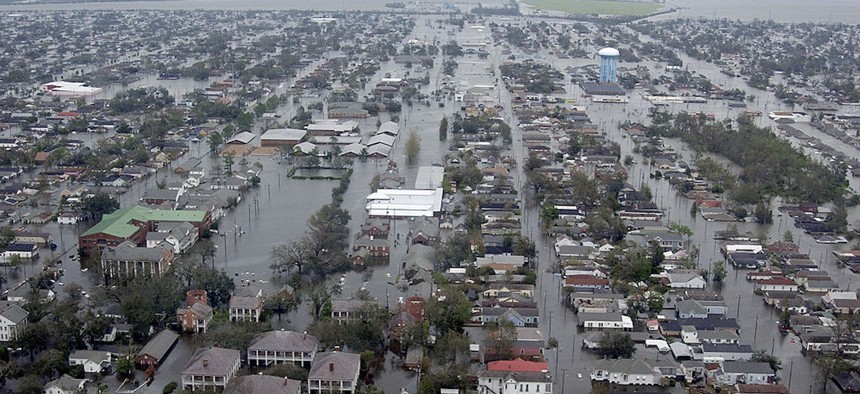
Flooded neigborhoods can be seen as the Coast Guard conducts initial Hurricane Katrina damage assessment overflights August 29, 2005 in New Orleans, Louisiana. Kyle Niemi/US Coast Guard via Getty Images
COMMENTARY | Make continuity planning an operational discipline rather than a compliance exercise.
One of the most vivid lessons from my Public Buildings Service career came from a building manager responsible for a federal courthouse in downtown New Orleans during Hurricane Katrina.
As floodwaters rose and much of the city lost power and communications, he faced a situation no training manual had fully anticipated. Supply chains were cut off, transportation routes were impassable, and communications systems were unreliable at best. There was no playbook for a disaster of that magnitude.
What he relied on instead was preparation, relationships and resourcefulness as he worked through the night to secure and preserve the historic courthouse.
That story stayed with me during every continuity exercise and operational planning session throughout my years supporting the Public Buildings Service and federal IT continuity of operations (COOP). It reinforced something that every government technology leader eventually learns: continuity is not a binder on a shelf. It’s a living capability that must be built, practiced and refined long before a crisis occurs.
During my time leading IT COOP functions, our teams planned and exercised scenarios across the spectrum of modern threats. These included natural disasters affecting federal facilities, extended power outages impacting data centers and telecommunications infrastructure, civil unrest disrupting transportation and staffing availability and enterprise-scale cybersecurity incidents affecting mission systems.
While each scenario had unique characteristics, four factors repeatedly proved decisive whether organizations maintained operations or became overwhelmed by the scenario.
The first factor is communication.
In any major incident, primary communication systems are often the first capability to fail. Networks go down. Cellular towers become overloaded. Email systems become unreachable.
Organizations that maintain situational awareness during a crisis are those that have established redundant communication channels in advance. That means more than knowing satellite phones exist somewhere in the organization.
It means pre-positioning alternate communication devices at key locations, training personnel on how to use them and establishing out-of-band communication protocols that operate independently of primary networks. These systems must be exercised regularly so teams know how to use them when stress levels are high and time is limited.
Continuity planning must assume that primary systems will fail. The goal is ensuring operations do not fail with them.
The second factor is supply chain resilience.
One of the earliest lessons from the response to Katrina was how quickly supply chain assumptions break down during a regional disaster. Vendors cannot reach affected areas. Fuel deliveries stop. Hardware replacements that normally arrive overnight may take weeks.
For federal agencies that rely heavily on specialized equipment and service providers, this creates significant operational risk.
Resilient organizations address this risk by asking difficult questions of their partners before an incident occurs. Where are vendor warehouses located? Could they be affected by the same regional event that impacts agency facilities? What inventory exists today for critical equipment and consumables? Can shipments be redirected to alternate facilities if primary locations become inaccessible?
Supply chain resilience is often viewed as a procurement issue. In reality, it is a strategic continuity function that must be integrated into COOP planning from the outset.
The third factor is the ability to reconstitute operations quickly from an alternate site.
The true test of a COOP program is not the existence of documentation but whether an organization can resume mission-critical functions fast enough to maintain its responsibilities to the public.
Speed matters. Every hour of downtime can affect citizen services, regulatory oversight and public trust.
Successful reconstitution depends on three elements working together. First, access to critical records and documentation. System configurations, operational procedures and mission data must be accessible from alternate locations through secure and verified backup systems.
Second, clear chains of command. During a crisis, ambiguity about authority can paralyze an organization. Personnel must know in advance who is responsible for key decisions and who assumes authority if primary leaders are unavailable.
Third, delegation of authority. When primary decision-makers cannot be reached, other personnel must be empowered to act. Delegation is not a bureaucratic formality; it is a fundamental requirement for operational continuity.
The fourth factor is technology readiness.
Modern federal operations depend on complex digital systems, which means continuity planning must account for the resilience of networks, applications and data environments. Agencies must determine which systems are truly mission-critical and define the minimum viable environment required to restore those capabilities.
This may include redundant network paths, alternate data center or cloud environments, endpoint management tools capable of operating in degraded network conditions and secure out-of-band administrative access.
However, the most important step is testing.
A system that has never been exercised during a continuity drill remains an unknown quantity. The worst time to discover a configuration error or access control issue is during a real-world incident.
Organizations that recover most effectively from disruptions share one additional characteristic: continuity is embedded in their culture.
Leaders regularly ask “what happens if” questions during planning and procurement discussions. Staff time is dedicated to exercises and scenario planning. Gaps discovered during testing are treated as valuable intelligence rather than problems to conceal.
Today’s federal agencies face an expanding range of potential disruptions. Natural disasters remain a constant risk, but they are now joined by cyber threats capable of disabling systems across entire enterprises, geopolitical instability affecting supply chains and infrastructure failures that can cascade across interconnected networks.
Make continuity planning an operational discipline rather than a compliance exercise. The next major disruption is on the horizon. The question for federal technology leaders is not whether their organizations will face disruption but whether they will be ready when it arrives.
Erika Dinnie joined MetTel as the Vice President, Federal Strategy & Planning, to further expand MetTel’s growing Public Sector team based in Washington, D.C. Prior to joining MetTel, Ms. Dinnie served as the GSA’s Associate CIO for Digital Infrastructure Technologies for nearly ten years, overseeing GSA’s IT infrastructure, systems, software, and applications for its 17,500-user base. Before joining the GSA, Ms. Dinnie was Assistant Commissioner, Head of Workplace Services for Public Buildings Service (PBS) from 2011-2014.