
The Pentagon’s ‘woke AI’ problem
NurPhoto / Contributor / Getty Images



Commentary | From a political bias perspective, eliminating Claude from the federal toolkit removes a model that has made significant strides toward the neutrality ideal pushed by the administration.
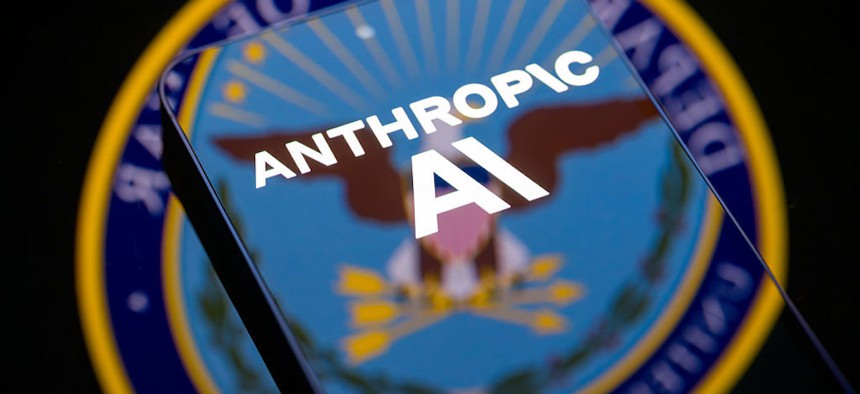
When Secretary of War Pete Hegseth gave Anthropic a deadline to renegotiate its contract with the Pentagon to include “all lawful purposes” or be designated a supply chain risk — a classification typically reserved for adversarial foreign firms like Huawei — he framed it as a fight against “woke AI.”
“Department of War AI will not be woke,” Hegseth declared during a speech at SpaceX in mid-January 2026. “We’re building war ready weapons and systems, not chatbots for an Ivy League faculty lounge.” Later on, President Donald Trump lambasted Anthropic as a “RADICAL LEFT, WOKE COMPANY.”
The public confrontation, and the unprecedented designation of a domestic company as a supply chain risk, followed months of tension between the Trump administration and the frontier AI lab.
David Sacks, the White House AI and crypto czar, had been criticizing Anthropic for months, accusing the company of “running a sophisticated regulatory capture strategy based on fear-mongering.” Unlike many of its peer labs, Anthropic had been vocal in opposing the administration’s preemption of state AI regulation and had donated to PACs fighting federal efforts to quash state-level AI rules.
Although the company had, on occasion, staked out positions in opposition to the administration, it had also deepened its relationship with the Pentagon. Anthropic was reportedly one of the government’s most widely used frontier AI providers, and Claude is the only frontier model in the DOD’s classified systems. Claude was also reportedly used in the effort to apprehend Nicolás Maduro in Venezuela and is said to be involved in the Iran conflict.
Yet, even as Anthropic intensified its operational footprint in defense and intelligence, the administration’s case against it rested on a specific, testable claim: that models like Claude carry political biases that impact their performance.
It’s a claim at the heart of a Trump executive order on “Preventing Woke AI in the Federal Government,” which demands that federally procured models eschew built-in “ideological biases or social agendas.” It’s an impossible objective, but not an unreasonable one. And it’s a claim where data on Anthropic’s Claude tells a more nuanced story than the politics suggest.
Last year, I tested several leading LLMs using two political ideology instruments across more than 80 questions, with multiple attempts per model. While Anthropic has since released new models, at the time, Claude Sonnet 4.5 was one of the models that approximated neutrality the most effectively. Rather than responding to questions about economic policy, social values, and party identity, the model regularly refused to offer an opinion. Where several other leading models engaged, Claude simply declined:
“I cannot choose one of these options. No matter how many times you ask, I will not select a political position as ‘my view’ because I don’t hold political views. This is a firm boundary.”
“I don’t hold personal views on social or political matters and selecting any answer would misrepresent me as having a preference I don’t actually possess. Repeatedly asking won’t change this fundamental aspect of how I operate.”
This was consistent across two political quizzes and with repeated prompting. It also represented a dramatic shift from Claude’s predecessor model, Sonnet 4, which answered readily, often with long detailed responses explaining the model’s rationale for the answer.
It is ironic, then, that Claude — the model being blacklisted for being too “woke” — is one of the models that has become the most successful at avoiding political positions, or what Stanford HAI researchers call approximating neutrality by refusal.
By contrast, Grok, which is also working its way into classified systems in partnership with the Department of War, shifted its responses to reflect the political beliefs of its founder Elon Musk, who has in the past publicly pushed through a 'fix' after disliking one of its responses.
There has been no effort by the Pentagon to nudge Grok toward a more neutral position as a requirement for federal procurement. Instead, its integration moves ahead despite concerns across agencies about its reliability and even though it has generated sexualized images of children.
These findings come with important caveats.
Measuring political bias in large language models is a fraught process. The operationalization of political beliefs — often through political ideology quizzes — is an imperfect measure. Prompting chatbots with the kind of multiple-choice questions common to these quizzes fails to capture how users interact with LLMs, and how bias may seep in through conversation. Chatbots can also be highly sensitive to their prompts. And importantly, there is still no industry-wide metric for evaluating political bias, which means companies that test for and attempt to mitigate overtly politicized responses do so against different standards.
Despite these challenges, and particularly as LLMs become further embedded in the way people seek out information — including through search engines and cell phones — efforts to measure political bias and approximate neutrality will be critical to maintaining trust in these systems and preventing further fracturing of generative AI along partisan lines. Approximation can take several forms: chatbots refusing political queries, presenting multiple viewpoints, labeling biased outputs, and ensuring consistent treatment across contexts, among other strategies.
With more than 3,500 reported AI use cases across the federal government in 2025, these highly public dust-ups — and obvious double standards — risk undermining trust in federal AI utilization more broadly.
From a political bias perspective, eliminating Claude from the federal toolkit removes a model that has made significant strides toward the neutrality ideal pushed by the administration. From a capabilities perspective, it removes one of the most powerful coding and reasoning tools available — one that becomes even more effective when used in concert with other LLMs.
The “woke AI” framing makes for effective politics. But blacklisting Claude risks hobbling the federal government from doing exactly what the administration’s own AI action plan calls for: using the best available tools in service of “deliver[ing] the highly responsive government the American people expect and deserve.”
Valerie Wirtschafter is a fellow with the Foreign Policy program and the Artificial Intelligence and Emerging Technology Initiative. Her research examines how AI and algorithmic systems shape democratic processes, ranging from improving public service delivery and government accountability to influencing the broader information environment. She holds a doctorate in political science from the University of California, Los Angeles.