
The revolutionary new weapon in the Pentagon’s pocket — and why it matters now more than ever
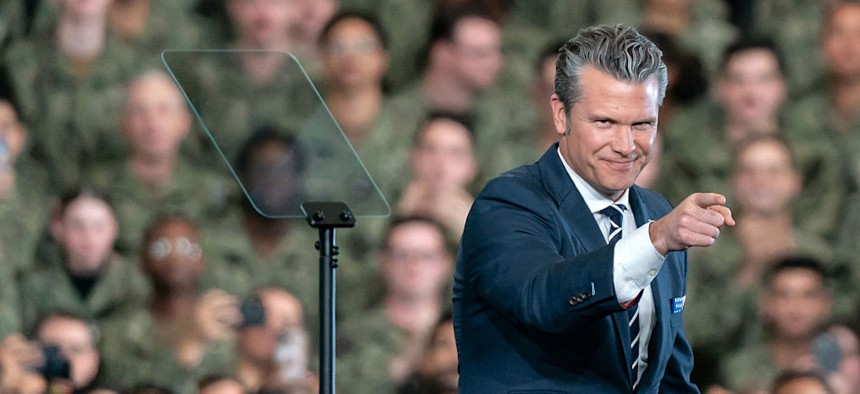
U.S. Secretary of War Pete Hegseth delivers a speech ahead of the arrival of President Donald Trump aboard USS George Washington on October 28, 2025 in Yokosuka, Japan. Tomohiro Ohsumi/Getty Images





 By
Jim Carroll
By
Jim Carroll
COMMENTARY | The launch of comprehensive acquisition transformation will lift the burdens keeping U.S. companies from being as agile and responsive as possible.
Much of the work being done by the federal government reflects how the United States is bracing for a wartime footing to compete with adversaries such as China. The Pentagon is leaning heavily into the development of technologies that truly have cutting-edge warfighting capabilities — from the Manta Ray system being developed by DARPA that uses the motion of waves to power lethal autonomous underwater drones, to Project Convergence, which is testing the use of AI to instantly unify all branches of the military to respond to global threats.
The focus on these technologies and similar projects will result in superior warfighting capability. However, there is another revolutionary weapon under development that deserves equal attention.
This new weapon is not just discussed in hushed whispers in one of the many SCIFs at the Pentagon. It has been discussed in the Trump administration, on Capitol Hill and even in the media. This new non-secretive project was discussed openly in the “Arsenal of Freedom” public speech given by Secretary of Defense Pete Hegseth on November 7. The new weapon is the launch of a comprehensive acquisition transformation that will lift burdens American companies currently face that prevent them from being as agile and responsive as possible.
While this might sound pale in comparison to autonomous drones and AI-enabled missiles, the reality of unleashing American companies to do their cutting-edge development will yield a significant battlefield advantage.
The administrative burdens the secretary is seeking to transform are not the fault of people inside the federal government or within the Defense Industrial Base working to meet the warfighter’s requirements, but the processes embedded in the Pentagon’s acquisition system. While progress has been made from previous acquisition reform efforts, in most cases the warfighter is still not receiving the products or services needed at the cost, schedule and performance anticipated.
Secretary Hegseth opened his “Arsenal of Freedom” speech by quoting former Secretary Donald Rumsfeld’s speech on acquisition reform, which notably was delivered on September 10, 2001.
What is the difference this time? Acquisition reform is certainly not new to the Pentagon. In fact, in many ways it is that “shiny object” that has been discussed for decades while various efforts have been made to decrease timelines. What sets this effort apart from others is that it makes significant changes to the requirements, acquisition and foreign sales processes in parallel.
It appears Congress and the Pentagon are working together on these timely changes to build off of and enforce the successes of prior work (e.g., Mine-Resistant Ambush Protected (MRAP) vehicles). The secretary’s guidance was clear and direct to Pentagon leadership — to remove bureaucratic processes and realign structure to shift from a culture of compliance to rapid and mission-focused execution.
These points are further supported by the Pentagon’s new strategy that calls for increased domestic industrial base resilience, more competition (including commercial suppliers) and expectations that industry will invest in upgrading facilities, workforce and capacity to meet demand signals. This will require better communication and partnerships between the government and the industrial base to incentivize innovation and competition. The next 30-90 days will demonstrate whether this transformation moves at the aggressive speed needed to make this change with wartime urgency.
The current footing with Beijing has given the West limited insight into the Chinese method of awarding defense contracts to state-owned enterprises. As you might imagine, the legal constraints are limited and there seems to be enormous amounts of cash thrown at the state-run companies that are developing the latest firepower, of any kind, to take on the U.S. and our allies. While the Chinese method is inherently communistic, corrupt and stifles innovation, it can produce results in quick order.
Thankfully, the system overhaul proposed by Secretary Hegseth is not only perfectly legal, but it is also a revolutionary change that truly benefits the taxpayer and, most importantly, the warfighter.
Without the currently burdensome regulations that create restraints and stifle innovation, the Defense Industrial Base can create the weapons that will safeguard the U.S., our economic and national security concerns and defeat our adversaries.
Jim Carroll is CEO of the Professional Services Council, a trade association representing approximately 400 federal contractors to the legislative and executive branches of government. With over 30 years of experience in government and the private sector, he has held senior roles under two U.S. presidents and served in key positions at the White House.