
The government AI experiment Is working. Now scale it up.
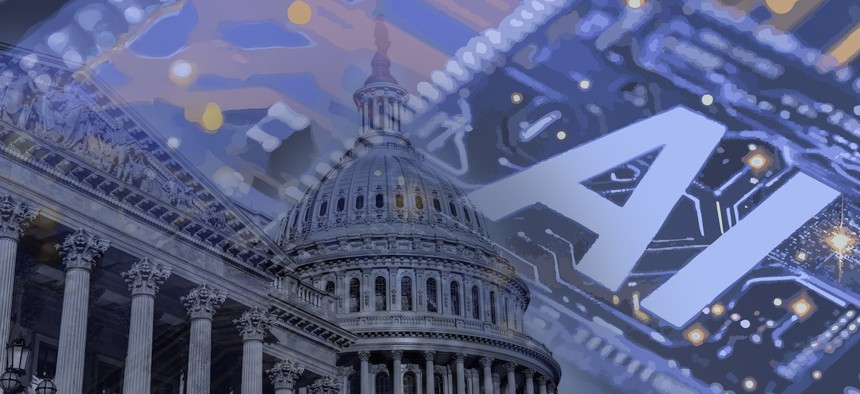
Greggory DiSalvo/Getty Images

COMMENTARY | It's time to move beyond pilot programs to the systems that will serve all Americans better.
Resource constraints and growing demands often challenge the aspiration for a federal government that serves all Americans effectively and efficiently — delivering timely benefits, responsive services and reliable infrastructure. But what if the answer isn't choosing between fiscal responsibility and quality service? What if we could deliver both through strategic investment in a transformative technology that's already proving itself?
Take, for example, the Wisconsin Department of Safety and Professional Services. By using AI to speed up licensing, they saw a 35% increase in the number of licenses issued between 2023 and 2024, adding $54 million in additional wages for workers in the state. California's DMV improved satisfaction from 2.5 to 4.25 out of 5 (who wouldn’t love to avoid the lines and paperwork?). This was before AI agents. Just imagine if the federal workforce had a team of digital workers available around the clock to process applications and support citizens.
This isn't about replacing federal workers; it's about empowering them. Consider what we're already losing to inefficiency. The federal government loses $162 billion annually to improper payments — money that could fund infrastructure, research or tax relief. Citizens wait months for benefits decisions that AI could accelerate to weeks. Small businesses delay expansion while waiting for permits that AI agents could process around the clock.
Unlike the automation and chatbots the government has experimented with before, AI agents can learn, reason and make decisions. In other words, they operate as highly capable digital workers that tackle the repetitive, error-prone and high-volume tasks that create bottlenecks for both government employees and the citizens they serve.
If digital labor is applied to the full spectrum of federal interactions with the private sector, from streamlining national project approvals to accelerating small business formation and expansion, it can unlock unprecedented opportunity.
How to address concerns upfront
As someone who has worked closely with government technology implementation, I know success doesn't happen by accident, so let's be honest about the challenges. Citizens worry about privacy and accountability. Workers fear job displacement. Taxpayers question whether this is just expensive technology theater. These concerns are legitimate and must be addressed systematically.
You must start with the business’s need then select the right technology. Everything depends on clean, connected data, and sometimes that data needs to be "interpreted" between systems, which requires dedicated data leadership with substantial teams.
On privacy and security: Transparency is essential. Agencies must tell citizens upfront that they're using AI, what data they're using and how it's being handled. We have laws in jurisdictions across the country about data use and retention. The government must follow those scrupulously. The key is building auditability into every system from day one.
On workforce impact, the evidence shows AI creates opportunities, not just disruption. But it requires genuine commitment to reskilling. This isn't traditional "change management" — it requires leadership, what I call "trailblazers." It's about taking risks, failing and learning from failures. That's why measured, progressive steps are crucial.
On implementation costs and complexity, smaller agencies need not be left behind. The choice isn't between billion-dollar custom solutions and changing nothing. Modern AI platforms offer "no-code, low-code or pro-code" options that can start simple with basic functions and grow more sophisticated over time.
A roadmap that works
From my experience with government AI deployments, the most successful efforts follow a proven pattern:
Start simple: Begin with basic FAQs and routine inquiries. Build trust with users — both employees and citizens. Avoid the "big bang" approach. Start with simple applications, then build trust with users and gather their feedback continuously.
Add complexity gradually: Move to summarization and recommendations, then basic decision-making and finally autonomous actions — but only with continuous feedback and auditability at every step.
Invest in infrastructure: Success requires what I call a "data czar" who leads a substantial team. They also need prompt engineering capabilities and robust audit systems. Agencies must avoid data "multiplication" — they don't want to make copies of data but want direct access to the sources. Any copy becomes stale the second you make it.
Focus on adoption: Technology doesn't deliver value; adoption does. Agencies must diligently capture feedback and ensure auditability while being transparent with audit results. Remember that this technology isn't deterministic; results may vary, and that's normal. That's why auditability is critical.
The unique government challenge
In the public sector, we have thousands — millions — of "bosses": all of our stakeholders are the public. This means we must be prepared to answer any question about the technology, hence the emphasis on auditability. We also have a huge IT estate, and many of these systems are quite old. The ability to reach into data from legacy systems is a major challenge, making data connectivity and adaptation critically important.
This requires systematic management. As a base function of any system, agencies need to manage, monitor, audit and correct AI agents. Enterprise architectures will likely change, but this should be managed and manageable. The interdependence of people, processes and technology becomes even more evident. You can see how the human workforce will continue to play a key role as these systems evolve and develop.
Aspiration to achievement
Congress should structure appropriations to support multi-year AI initiatives with measurable milestones. Agencies need authority to move quickly while maintaining strict oversight. And we need public-private partnerships that leverage innovation while preserving democratic accountability.
Based on what I've seen work, my advice to agency leaders is simple: Don't do nothing. Start now. Take progressive steps. Gather feedback, keep audit trails, tune continuously. Focus on adoption and prove the solutions are working to your users, both the public and your employees.
The aspiration for a government that serves all Americans effectively is an achievable goal. But only if we act with the urgency this moment demands and the wisdom that experience provides. The technology is ready. The question is whether we are.
Paul Tatum leads a global team responsible for the overall technical direction and architecture of solutions that help governments, nonprofits and education institutions leverage AI and cutting-edge technology to modernize, scale and enhance their business and services. Prior to joining Salesforce, Paul spent 25 years at Northrup Grumman, Sun Microsystems and Oracle, where he focused on building and deploying solutions for all levels of government, nonprofit and education organizations.