
The chip in my hand and the chip in her brain
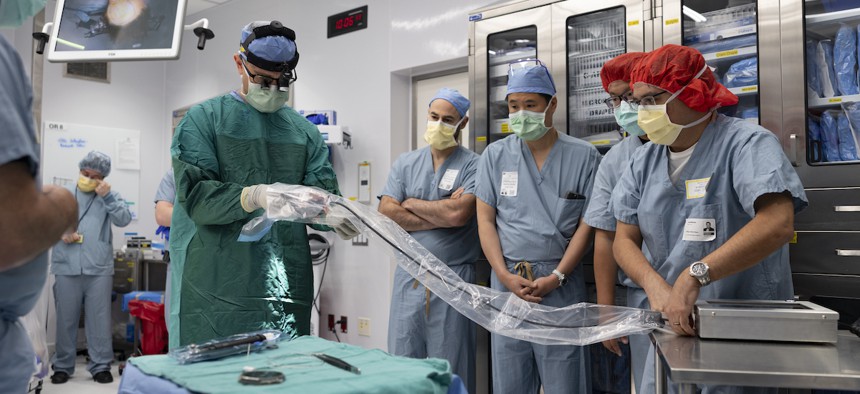
Dr. Matthew Willsey connects the internal and external transceivers to test the device diagnostics. Photo courtesy of Paradromics




Implanted chips are are moving from novelty to clinical reality.
Ten years ago, I went to a chip and beer party in Stockholm. I wasn't there to drink. I was there to have a chip implanted in my hand.
I did it out of curiosity, mainly because it sounded cool. The chip is an RFID implant the size of a grain of rice, tucked between my thumb and index finger. Scan my left hand with a phone and my contact info pops up.
A decade later, the chip is still there. Other implantees have programmed theirs to unlock doors, start cars or store health records. Mine stayed a party trick and a good story. But the idea behind it, putting hardware inside the body to talk to machines, stayed with me.
Last month, surgeons in Michigan placed a brain-computer interface called Connexus into a human brain. It belongs to Paradromics, an Austin-based neurotechnology company that got FDA approval last fall to begin a clinical trial.
The participant is a woman with motor neuron disease that has taken most of her ability to speak. The implant reads individual neurons through 421 microelectrodes that sit 1.5 millimeters into the motor cortex. The signals run down to a transceiver in her chest, which beams them out to a receiver, and AI turns them into words on a screen.
Paradromics spent a decade building toward this surgery. I asked CEO Matt Angle, a neuroscientist by training, how it felt.
"When someone is trusting you to put a brain implant in their brain, that's a massive duty of care," he says. Mostly, he remembers relief that the surgery went well and she recovered, then excitement about what they could do next. "There's a real human component to that."
What they're doing next is rehab. A machine learning algorithm is learning to read her brain and produce speech, and she's relearning how to use a voice and the device. This is what the clinical phase looks like, Angle says.
I asked what people get wrong. The misconception he names comes from his own industry.
"One of the misconceptions about brain-computer interfaces is that it's currently a niche field, and that it won't be big until everyone gets a BCI and we all live in the Matrix," he says.
That story pulls in investors, he admits, but it makes people lose sight of the next decade: turning untreatable biology problems into solvable technology problems. Restoring speech alone is a market worth tens of billions of dollars.
The implants can also pick up brain states tied to mood and cognition, which puts mental health in range. Angle pictures one working like a continuous glucose monitor for the brain, flagging when your medication is wearing off. The same readout could steer deep brain stimulators and other neuromodulation devices built by companies already in that business.
"I think there's going to be a revolution in not the next 50 years, but in the next 10 years in mental health, as we start using brain-computer interfaces to read out signatures of mental illness," he says.
Biology is slow, he says, and cures win Nobel Prizes maybe once a decade, while technology iterates much faster.
"Regrowing a spinal cord could be a hundred-year project, but reading someone's intention to move a wheelchair or move a robotic arm, control a computer based on brain signals, you can do that right now," he says.
The biggest problem ahead for Angle and his team is reimbursement, which has nothing to do with neurons. First-in-class devices have no billing codes, and Medicare moves slowly on them. Angle points to RAPID, a new FDA-CMS effort that would start Medicare's coverage review the day a breakthrough device clears FDA, slashing a wait that has run a year or more.
I told him about the story I read a few years ago, of a company that built bionic eyes, ran out of money and left patients with dead hardware in their heads. Angle's fix is also about money: stop paying for implants in one lump sum and move to ongoing support payments, closer to a software subscription.
"If there's a market for providing software support, providing application support on an ongoing basis, then you wouldn't see that kind of abandonment," he says.
Angle wants that same whole-of-government approach at home. The U.S. leads the field technically, he says, but the government gets in its own way. China published reimbursement codes and payment numbers for BCI surgeries before it approved a single device commercially. Knowing what a device will pay takes risk out of the bet, he says, and lets investors put more money into the field.
If nothing were impossible, what would the future of BCI look like?
Angle's dream has BCIs that don't repeat what he calls "the sins of the past tech era," naming Facebook and TikTok, where users stopped being the customer and their attention got sold. Because implants read intent, he argues, they could handle life's admin without the constant pinging.
"Most people who spend a week without their phone are happier," he says. "That's not a good sign, that these powerful technologies that are with us all the time make us less happy. But BCIs could be a lot different than that."
He imagines them handling the same services we juggle now, calling an Uber, buying groceries, without us having to look at anything. "The AI is just constantly working on our behalf and understanding our intentions without stealing our attention," he says.
That part of the future, at least, I can vouch for. My chip has never pinged me, never sold my attention and never bothered me once in 10 years — but it also does almost nothing. Whether anyone can build hardware that stays that harmless while reading a mind is the open question.