
To Ben Lamm, extinction is just an engineering problem
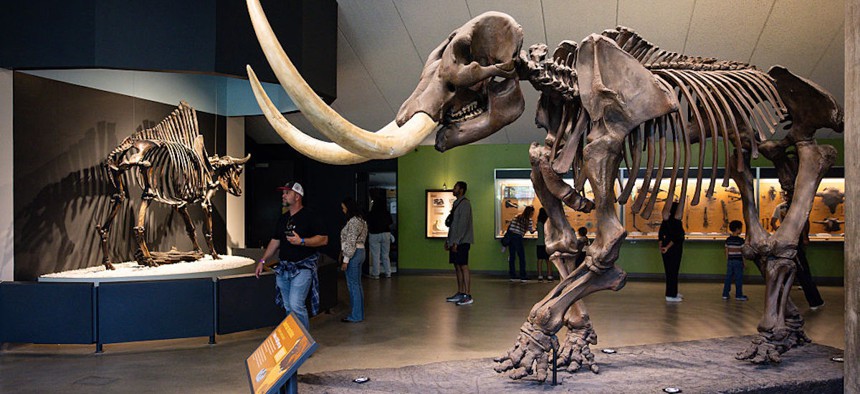
Visitors look at dinosaur fossil skeletons at the La Brea Tar Pits and Museum on Thursday, May 28, 2026, in Los Angeles, CA. Kayla Bartkowski / Los Angeles Times via Getty Images






Colossal Biosciences CEO Ben Lamm explains how ancient DNA, AI and CRISPR are helping scientists pursue de-extinction.
Drill into a piece of ancient bone in one spot and you get nothing. Move a quarter inch over and you get tons. Ben Lamm calls it luck of the draw and that's where resurrecting a species starts. The DNA comes from bone stored in museum drawers, permafrost cores or a cave on the South Island of New Zealand—anywhere something died cold and dry enough to preserve it for a few thousand years.
Lamm is the CEO of Colossal Biosciences, which he started in 2021 with Harvard geneticist George Church to bring back the woolly mammoth. It has since taken on the dodo, the moa, the bluebuck and the Tasmanian tiger. In 2024, it produced the animals that made its name: Romulus, Remus and Khaleesi, three dire wolf pups from a species gone roughly 12,000 years (or gray wolves with 20 edits, depending on which scientist you ask). Scientists pulled DNA from ancient fossils, edited the cells with CRISPR, cloned the embryos and used domestic dogs as surrogates.
None of this is straightforward. Nothing involving gene editing ever is. I reached out to Lamm to get an explainer on how you bring back an extinct species. He's a systems guy, not a scientist. He built and sold five companies before this, the last an AI firm called Hypergiant. Now, Lamm says, the goal is to "do really great work and push societies forward." He runs Colossal like a product company, not an academic lab, which is part of why he frames de-extinction as engineering rather than science fiction.
Lamm has answered the Jurassic Park question untold times, so I don't ask it. I ask what people never think to: what they get wrong.
What they get wrong, he says, is thinking de-extinction and conservation compete. They're the same fight. People land in two camps. One thinks you can bring back anything, which is where Lamm breaks bad news: "Sometimes you make people sad [when] we tell people there is no dino DNA." You can't build a genome out of nothing.
The other camp says the mammoth money should go to species still alive. Same answer either way. De-extinction is one more tool inside conservation. Not an or but an and.
His case: We're in the sixth mass extinction and we could lose up to 50% of biodiversity in the next 25 years. Conservation works but needs new tools. So, Colossal open-sources its tech for partners and runs more conservation projects than de-extinction ones. Right now, 75 partners worldwide use it.
"Most things like mammoths get the headlines," Lamm says. "Saving elephants doesn't get the headlines."
The mammoth is the hard one, though. Ancient DNA shows up degraded and broken, mixed with microbes, defecation and whatever else got into the sample over a few millennia. The first job is filtering, work for Colossal’s top ancient DNA experts.
Then comes the reconstruction, where AI is used. The team sequenced living elephants to build a reference genome, aligned the broken ancient fragments against it and flagged the differences, the places where mammoth DNA diverges from elephant DNA. Lamm calls the output ancestral state reconstruction maps, a best guess at the original genome.
Colossal first targeted around 60 genes. It has now made over 100 edits, some synthesizing a big piece of the genome, others changing a single nucleotide. The traits are the recognizable ones: the shaggy coat, the tusks, the small ears, the domed cranium, the subcutaneous fat layer and the cold-tolerant nerve endings.
Something has to carry the pregnancy. For now, that's an elephant, roughly two years. Colossal is also building artificial wombs, one for birds, one for marsupial-type mammals that gestate outside the body.
None of the first de-extinct animals will come from a machine, though. "Those will be born, hopefully, in the coming generations," Lamm says.
I asked what happens after the calf is born. Romulus, Remus and Khaleesi already show the answer is complicated. The wolves live at a secret U.S. facility on a 2,000-acre preserve, according to a 2025 TIME article, with no plans to release them into the wild. They're a conservation tool, not a species set loose.
Making one animal isn't the point, Lamm says. Herds are, with real genetic diversity, out in the environment and monitored. That means rewilding models, and rewilding models mean people: landowners, indigenous groups, governments, the public, animal rights groups. Colossal doesn't even get to keep its animals.
"We can't be stewards of these animals," Lamm says. The company works with governments to protect and support them. You bring the mammoth back—and then you hand it over.
Rewilding also means arguments about impact. Some models show mammoths lowering Arctic ground temperatures by 9 to 12 degrees, others say less. Strip the big herbivores and carnivores from an ecosystem and it unravels. Put cold-tolerant megafauna back, Lamm says, and the consensus points to a net gain for the Arctic—though nobody has measured how big.
By now, Lamm has put de-extinction on global front pages, built Colossal into a company valued around $10.3 billion and earned a spot on the 2025 TIME 100 Next list. I ask him for his moon shot, the one problem he has yet to solve. He first says artificial wombs. Then he lands on the one he really wants: cryopreservation and reanimation.
“Suspended animation is an area that I'm really, really passionate about,” he says, referring to freezing a living thing and bringing it back to life later. Colossal already does it with cells. What Lamm wants is to do it to a whole animal, freeze it and revive it intact.
"That'd be pretty cool," he says, which is a very Ben Lamm way to describe one of biology's hardest problems. “We don't believe in impossible. Most things are just engineering challenges, right? They're not impossible.”