
Video games and virtual reality are combining to make government jobs safer
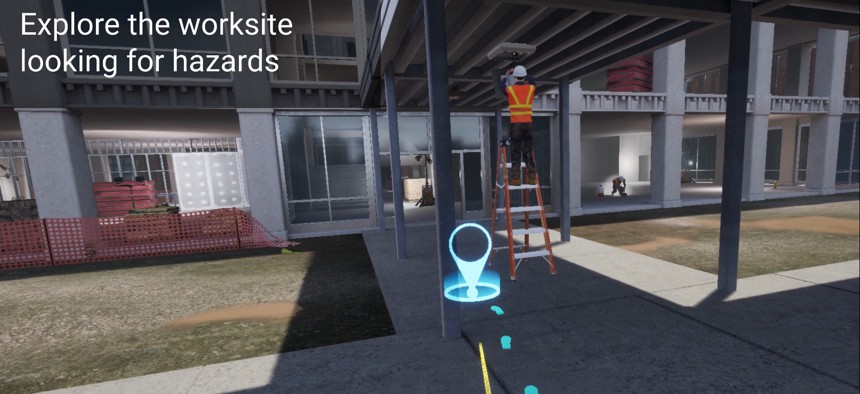
A screenshot of the USACE Safety Trainer 360 shows the first-person perspective of a user navigating the simulated construction site. Kristen Bergeson/U.S. Army Corps of Engineers





The combination of the two technologies is enabling agencies to give employees hands-on training in the safest environments possible.
Most job-related safety training is pretty basic and involves either listening to a presentation about where the emergency exits are located or learning basic life-saving techniques, like how to “stop, drop and roll,” should you somehow happen to catch on fire while walking around the office. Many of us don’t need very advanced training because our workplaces are thankfully located in relatively safe environments.
But safe office spaces are not always part of the standard fare for a few brave government workers. There are feds who inspect construction sites for safety, respond to hazardous material spills or who perform other dangerous duties where the risk to life and limb is much greater than getting a nasty papercut. For them, even on-the-job training is difficult to obtain, since that often requires recreating hazardous conditions.
But now, some federal agencies are turning to an innovative technology to help out: video games. We’ve covered video games in federal service before, although using them for serious work is rather rare in government. However, when you combine a video game’s ability to simulate almost any environment with another technology that helps to transport people into the game, it creates a powerful tool for both entertainment and critical training exercises. You just need to add a good virtual reality headset.
Virtual reality headsets have been around for many years. Nextgov/FCW was covering them and their applications over six years ago in places like NASA, research laboratories and even the E3 Expo video game trade show. The biggest drawbacks for training with them were the fact that they were kind of bulky to wear and often lacked the kind of graphical horsepower needed to simulate realistic environments. Some companies compensated by using separate servers to power game graphics, but that then required either a tethered connection back to the headset or really fast wireless connectivity.
An offshoot of VR, augmented reality, can also help reduce the size of headsets because it uses clear glasses that enable users to see the real world through its lenses, but with some virtual objects rendered into the resulting mixed reality. That can lead to some impressive-looking applications, but AR is limited due to the fact that users will still see whatever background is actually around them, making the augmented reality elements seem less real.
However, despite those limitations, some agencies are leaning into the science of combining virtual or augmented reality, video game technology and critical training. The U.S. Army Corps of Engineers and its Safety Trainer 360 game is a perfect example. It’s a virtual reality construction site game created by the Huntsville Center Safety Office and the Army Game Studio.
Those who train with the game equip themselves with modern virtual reality headsets that allow them to walk around a simulated construction site. The virtual site has everything found at a real one, including lots of equipment, walls and floors in various states of construction and even a busy cadre of workers going about their day trying to meet their deadlines. But scattered within that large maze-like worksite are plenty of hidden dangers, including scaffolding that is not properly braced or exposed live wires. Players are charged with spotting those hazards and fixing them, hopefully before any of the virtual people get hurt.
The construction game was developed by the Army Game Studio, which gained fame for creating the America’s Army game that has been used as a recruitment tool for years. They later designed the America’s Army: Proving Grounds title, which lets potential recruits, or anyone interested in combat tactics, experience what real infantry training is like.
“We’ve done several virtual reality games, but this one was unique in that it was a real place, so it involved modeling an environment with specific items like cranes and ladders,” said Daniel Kolenich, executive producer of Safety Trainer 360, when speaking with the Army public affairs office shortly after the construction game launched. “It was far more realistic than what we normally do.”
The construction game uses a modern Meta Quest 2 headset to drive the simulation. The headset is not too bulky, but doesn’t actually drive the simulation. Instead, the entire environment is run on a gaming laptop, with the headset used to display the graphics. The headset also acts as an input device so the simulation knows where players are located in the virtual construction site and what they are looking at or touching.
“VR is the latest technology, but not everyone has started using it,” Kolenich said. “In this case, it worked perfectly to meet the needs of our customer.” Safety Trainer 360 is now fully integrated into OSHA training in Huntsville, Alabama.
Meanwhile, the Environmental Protection Agency is tapping into immersive technology to get ready for even more dangerous situations, namely natural or manmade disasters. The EPA has developed an extensive library of training programs using both VR and AR technologies. Many of them are available for download on GitHub for free, although some require potential users to first request access. They also require a variety of different headsets and computing hardware. For example, their biological sampling simulator runs on a beefy Oculus Rift S tethered to a gaming system or server, while their chemical sampling game runs natively on a Meta Quest 2 headset.
There is a lot of variety in the EPA training games. One title called Waste Dash challenges players to race against time to identify different types of waste and develop strategies on how to best deal with them, while another teaches people how to safely measure radiation hazards without getting hurt or irradiated. There is even an EPA Flight Sim module designed for use with a VR headset and Microsoft Flight Simulator 2024 that teaches drone pilots how to identify oil spills and other hazards during flyovers.
The Army and the EPA might be the federal government’s current stars of virtual reality video game training, but other agencies may not be too far behind. According to a 2024 GAO report, 17 of the 23 civilian federal agencies surveyed said that they are either using immersive technologies for workforce training or plan to do so in the very near future. And for the ones that were already employing it, the benefits were tangible. Agencies using VR or video game technology reported better safety, higher trainee engagement and improved decision making.
By blending video game technology with immersive headsets, agencies are taking safety training beyond PowerPoint and into worlds that are very close to reality to give players something very close to real world experience. That matters, because when the stakes involve hazardous sites, chemical spills or disaster response, the best place to make mistakes is in a virtual world, not the real one. VR and AR won’t replace every kind of training, but they’re proving to be powerful tools that can help federal workers practice, prepare and ultimately come home safe.