
SSA’s lead had set a goal of 200M online accounts this year — experts say that might prove challenging
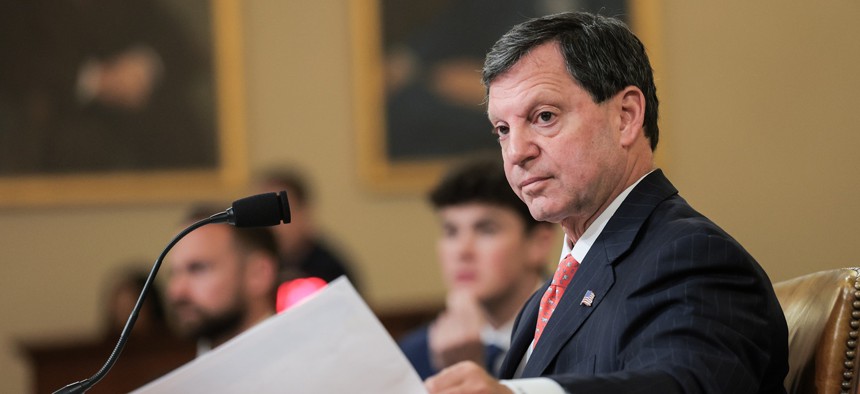
Social Security Commissioner Frank Bisignano listens during a House Committee on Ways and Means Subcommittee hearing on Capitol Hill on June 10, 2026 in Washington, DC. Anna Moneymaker/Getty Images


The Trump administration recently achieved 105 million online accounts, and lawyers are increasingly encouraging clients to make them as more services go digital.
The Social Security Administration hit its target of reaching 105 million 'my Social Security' accounts — an online portal Americans use to access services — by the end of the month, an agency spokesperson told Nextgov/FCW on Friday. The agency now aims to reach 110 million by the end of next September, per a strategic plan released in August.
But that 110 million goal is far less lofty than the target SSA Commissioner Frank Bisignano told Congress about last year: 200 million online accounts by the end of 2026.
The SSA spokesperson said the agency continues to strive for 200 million my Social Security account holders, but they did not offer a target date.
Boosting the number of my Social Security accounts is central to Bisignano’s push to transform SSA into a “digital-first” agency.
Nextgov/FCW spoke to over half a dozen lawyers, former SSA officials and other experts about the challenges the agency faces in reaching 200 million my Social Security accounts. Among them are the limited value of making an account for some Americans, a lack of awareness and account creation difficulties.
Amid the issues, lawyers and SSA employees are increasingly encouraging seniors and disability claimants to make online accounts.
“I see [my Social Security accounts] becoming, step by step, more and more relevant to the disability claim process as more is provided in there to the claimant,” David Camp, senior policy advisor and general counsel for the National Organization of Social Security Claimants’ Representatives, told Nextgov/FCW.
Account adoption challenges
Only 44% of adults report having a my Social Security account, including 66% of those aged 65 and older and 29% of those ages 18 to 49, according to AARP survey results published last month.
Adults generally interact with SSA in very specific moments of their lives, which explains much of the tepid adoption in the younger age bracket, Arabella Crawford, a civic tech consultant and Tech Viaduct contributor, told Nextgov/FCW. Those moments include turning 65, being diagnosed with a disability or changing their legal name, she explained.
Over 75 million Americans received Social Security benefits, Supplemental Security Income or both in August 2026, according to SSA data.
“I do not understand why you would expect the majority of Americans to create an account,” Crawford said.
The agency uses public service announcements, social media posts, targeted email and text outreach, agency notices and customer contacts to encourage Americans to make my Social Security accounts.
But even within the subset of Americans who do actively interact with SSA, other barriers to reaching the account goal exist.
Last year, attorneys at the Georgia Legal Services Program, a nonprofit law firm focused on serving rural Georgia, hosted four clinics to explain what my Social Security accounts are and helped about 100 clients make one.
Each clinic had at least two attorneys and was sometimes staffed by as many as five attorneys, Brittany Pasley, the firm’s public benefits specialist and a supervising attorney at the firm’s Augusta regional office, told Nextgov/FCW.
The program noticed that much of its clientele did not know about my Social Security accounts.
Many clients are also not technologically savvy, lack internet access or have disabilities that make it difficult to use technology, Pasley said.
Clients ran into issues using my Social Security accounts’ digital identity verification services, she explained. For example, some clients found it difficult to use video proofing on ID.me — a digital identity validation service used across several agencies — while others had to wait for the government’s in-house option, Login.gov, to send codes through the mail, she said.
Crawford told Nextgov/FCW that online digital identity verification services present a roadblock for other Americans.
The services can be hard to use for Americans who lack a current photo ID, are unhoused or face other difficult circumstances, she said, and the services can sometimes fail to verify someone’s identity through data matching.
Americans struggling with my Social Security’s digital identity verification services can use alternative options to create an account, including in-person verification at USPS locations for Login.gov and remote “trusted referee” video calls for ID.me.
Promoting online accounts
Though Americans face challenges in creating my Social Security accounts, lawyers are increasingly encouraging clients who interact with the agency to use the portal.
“In the past, we rarely encouraged clients to set up an SSA account — it was challenging to set up, and once you were in, the information available on the account was limited,” wrote Stephanie Akpa, head of policy and public affairs at law firm Atticus, to Nextgov/FCW. The firm represents about 100,000 disability claimants each year.
“That started to change last year. SSA made logging in easier, improved the user interface, and started showing more case status details online. Now we have a reason to encourage clients to make accounts, and we’re doing just that,” Akpa added.
In July, SSA announced that disability claimants can submit certain adjudication forms and track the status of their case online. Online account holders can also access proffer letters, which detail when new evidence is added to a case after a hearing, and 26 different kinds of notices. About 79% of Social Security customer transactions with the agency have occurred online this year, according to the most recent SSA performance data.
“SSA is continuing to expand my Social Security so that beneficiaries and other members of the public can complete more routine business securely and conveniently online,” an agency spokesperson told Nextgov/FCW.
But my Social Security still lacks some digital features. The bipartisan Social Security Advisory Board called for improvements to online wage reporting tools and a mobile-friendly app for Supplemental Security Income recipients in a July report.
Pasley said that, while the firm does not have immediate plans to host more clinics, attorneys continue to encourage clients to create online accounts.
SSA employees are also pushing Americans to create accounts.
Since last September, SSA has required teleservice center and field office employees to strongly encourage Americans to do so, according to Rich Couture, president of the American Federation of Government Employees Council 215.
Under the initiative, SSA employees offer to send callers and visitors information about creating my Social Security accounts after checking a system to see if the person has one.
But it’s “common” for callers and visitors to decline the employee’s offer, Couture told Nextgov/FCW.
The agency maintains it wants customers to have the option to be served through field offices and phone calls, though SSA has lost thousands of employees under the Trump administration, according to Office of Personnel Management data.