
Annual intelligence assessment doesn’t address foreign threats to US elections
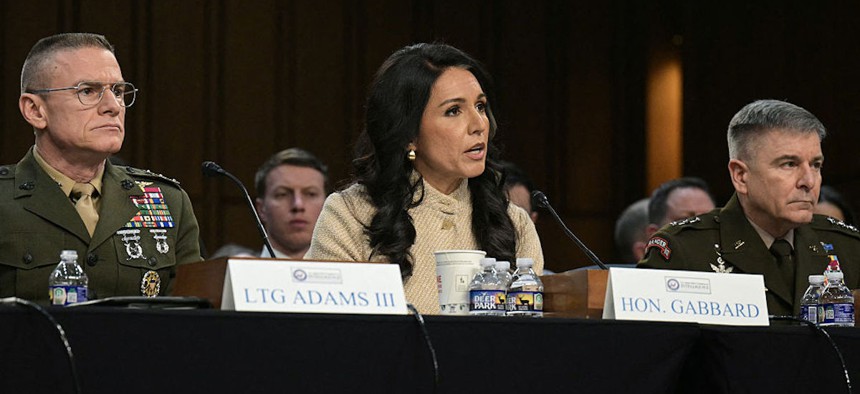
Director of Defense Intelligence Agency (DIA) James Adams III, US Director of National Intelligence Tulsi Gabbard, and Acting Commander of US Cyber Command William Hartman testify during a Senate Committee on Intelligence hearing to examine worldwide threats, on Capitol Hill in Washington, DC, on March 18, 2026. Oliver Contreras / AFP via Getty Images




In a hearing to discuss the assessment, Director of National Intelligence Tulsi Gabbard also offered mixed signals about Iran’s nuclear capabilities, with her written testimony differing from spoken remarks.
An annual intelligence assessment of worldwide threats to the U.S. omitted mentions of foreign threats to American elections for the first time in nearly a decade, a notable shift in a midterm election year that suggests the Trump administration is shifting focus away from a risk long treated as central to national security.
The assessment was delivered on the heels of a major global threats hearing in the Senate Intelligence Committee on Wednesday, where top officials including Director of National Intelligence Tulsi Gabbard and CIA Director John Ratcliffe testified about the ongoing Iran war and other top-of-mind matters.
The hearing highlighted growing tensions between intelligence assessments and the administration’s framing of the conflict with Tehran. It also came a day after the high-profile departure of Gabbard aide and National Counterterrorism Center Director Joe Kent, who said he could not agree with the Trump administration’s premise for the Iran war that began Feb. 28.
Gabbard drew ire from committee Democrats over election threats matters.
“Are you saying there is no foreign threat to our elections in the midterms this year?” Virginia Sen. Mark Warner, the panel’s top Democrat, asked Gabbard.
"The intelligence community has been and continues to remain focused on any collection and intelligence that show a potential foreign threat,” she said.
Gabbard has drawn scrutiny over her involvement in an FBI raid of a Fulton County, Georgia elections office that was at the center of President Donald Trump’s false claims of election fraud in 2020. Gabbard’s agency, in part, is charged with countering foreign election interference, and doesn’t have conventional authority to manage domestic election affairs.
Asked about this, she said the Office of the Director of National Intelligence has “purview and overview” over the Department of Homeland Security and the FBI, both of which “have purview over election security responsibilities to ensure the integrity of our elections.”
Gabbard said she only observed the raid and that she “did not participate in a law enforcement activity, nor would I, because that does not exist within my authorities.”
Gabbard’s election integrity efforts have involved multiple agencies and senior officials, including meetings this year with White House Chief of Staff Susie Wiles and then-DHS Secretary Kristi Noem to discuss election security and restoring public trust, a U.S. official previously told Nextgov/FCW. The discussions have also included outside figures like Kurt Olsen and Cleta Mitchell, both of whom have promoted claims that the 2020 election was stolen.
Warner also criticized intelligence agencies for not responding to committee requests for briefings regarding foreign election interference efforts.
Ire over Iran war
Gabbard said in her opening remarks on the Iran war that Tehran could face mounting pressure as its economy weakens, but warned that the country and its proxies “continue to attack U.S. and allied interests in the Middle East” despite setbacks before and after the conflict began.
But she notably deviated from her prepared remarks to the Senate panel and said Iran was “trying to recover from the severe damage to its nuclear infrastructure sustained during the 12-Day War” last summer, which concluded in the U.S. Midnight Hammer operation that targeted three key Iranian nuclear enrichment sites.
Per her written statement, she was expected to say Iran made “no efforts” since the U.S. bombing of their nuclear facilities “to try to rebuild their enrichment capability.” Those remarks could undermine the Trump administration’s motives to justify an attack on Iran, on the grounds that its nuclear program still posed a threat, among other reasons.
Warner asked Gabbard why her testimony diverged from her prepared remarks. She said she skipped some portions because “time was running long” during her opening statement, prompting Warner to accuse her of omitting “the parts that contradict the president.”
The state of Iran’s nuclear capabilities have especially been a flashpoint since the Midnight Hammer bombing last summer. A preliminary Defense Intelligence Agency assessment appeared to undercut Trump’s claims that Iran’s nuclear program was “obliterated” in those attacks, though the CIA soon after said it had evidence proving the program was severely damaged.
Ratcliffe told senators Wednesday that Midnight Hammer was successful and has slowed Iran’s nuclear enrichment efforts.
“We sit here today with Iran having exactly the same amount of enriched uranium to 60%, meaning they have been unwilling and uncapable, or incapable, of enriching uranium to 60%” as a result of the operation, he told Republican Sen. Mike Rounds of South Dakota.
Questions were also raised about other foreign adversaries sharing intelligence with Iran to target U.S. forces in the Middle East. Iran is “requesting intelligence assistance from Russia, from China and from other adversaries of the United States,” Ratcliffe told Sen. Jack Reed, D-R.I., declining to mention in public session if they actually are providing it. He said he knew the answer and would explain in a classified session.
Ratcliffe told Sen. John Cornyn, R-Texas, that he disagreed with Joe Kent’s claims about Iran, saying “intelligence reflects the contrary” about the Iranian regime.
Sen. John Ossoff, D-Ga., asked Gabbard if there was an “imminent nuclear threat” posed by Iran, referring to stances from the White House and its prior claims about Tehran’s nuclear capabilities being “obliterated.”
In a calibrated answer, she said it’s “not the intelligence community’s responsibility to determine what is and is not an imminent threat” and that the president has authority to make such conclusions.
The Constitution gives Congress — not the president — the authority to declare war, while the president, as commander in chief, directs military operations. But intelligence community analysts and officers frequently compile assessments from a range of sources and methods to inform policymakers, the president and others about the severity of threats.
“You’re evading a question because to provide a candid response to the committee would contradict a statement from the White House,” Ossoff said.