
CIA plans for ‘AI coworkers’, deputy director says
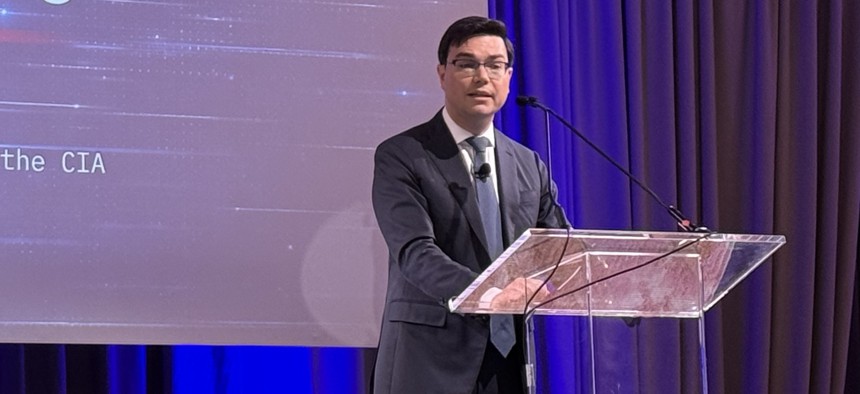
CIA Deputy Director Michael Ellis speaks April 9 at a Special Competitive Studies Project event. David DiMolfetta/Staff




The spy agency managed a few hundred AI projects last year, and recently used AI to generate an intelligence report for the first time, deputy director Michael Ellis said.
The Central Intelligence Agency aims to integrate artificial intelligence-powered “coworkers” into analysts’ workflows in the coming years as part of an effort to rapidly adopt the emerging capabilities for use in intelligence-gathering and analysis, a top official said Thursday.
CIA Deputy Director Michael Ellis said these AI coworkers would be housed in agency analytics platforms to help with basic tasks, though humans would still be looped into the process.
“It won’t do the thinking for our analysts, but it will help draft key judgments, edit for clarity and compare drafts against tradecraft standards,” he said in a speech at a Special Competitive Studies Project event focused on AI and the intelligence community. The AI tools would provide triage assistance and flag trends for human analysts to conduct further review.
Within a decade, the CIA will treat AI tools as an “autonomous mission partner” and officers will manage teams of AI agents in a hybrid model to increase the speed and scale of intelligence work, Ellis added.
Last year, the agency had more than 300 AI projects, and, for the first time in its history, AI was recently used to generate an intelligence report, he said.
The remarks provide a rare public glimpse into how one of the nation’s top spy agencies is integrating frontier AI systems into its day-to-day operations, and they signal that such platforms are expected to become a daily feature of officers’ workflows in the near future.
The CIA primarily executes and coordinates human intelligence gathering overseas, often done undercover. Officers recruit and manage foreign assets to clandestinely gather intelligence on areas like economics, terrorism and cyber threats.
Much of that work often involves the use of technology, though some have recently argued the advent of advanced AI tools may push the CIA more toward old-world tradecraft techniques.
But there have been benefits to technological investments. The agency recently elevated its Center for Cyber Intelligence into an entire mission center, a move that’s “paying dividends already by allowing us to deploy new tools to the field and gain more access to priority targets,” Ellis said.
“The battle of cybersecurity will be a battle of artificial intelligence,” and whoever capitalizes on the best AI models will wield “enormous power,” he added. “Having a new mission center centered around cyber intelligence will put us on the path to secure the upper hand.”
The agency also recently announced a new acquisition framework to overhaul how it integrates technology into its missions.
In an effort to track how foreign adversaries like China are using advanced AI and other technologies, the CIA doubled its technology-related foreign intelligence reporting, said Ellis. Those intelligence products focus on technology use abroad and can include findings on areas like semiconductors, cloud computing, infrastructure, cybersecurity or R&D.
Ellis did not mention Anthropic’s recent Project Glasswing announcement, a consortium announced earlier this week meant to help secure critical software against AI-driven attacks. The project was fueled by a powerful, non-public Anthropic frontier model the company says has already uncovered thousands of vulnerabilities but could be weaponized in the wrong hands.
The intelligence community and its industry partners are already examining and discussing how such a model may impact the future of cyber missions, Nextgov/FCW reported Wednesday.
Earlier this year, Anthropic declined to ease restrictions against its tools being used for domestic surveillance or fully autonomous weapons for Pentagon use, triggering a “supply chain risk” designation from the Defense Department and a White House order that all federal agencies phase out their uses of Anthropic tools. The company has legally challenged the move.
Ellis did not single out Anthropic specifically, though he cautioned that the CIA “cannot allow the whims of a single company” to constrain its use of AI and said the agency is looking to diversify across multiple vendors to preserve operational freedom.