
House panel approves slate of DHS intelligence reform bills
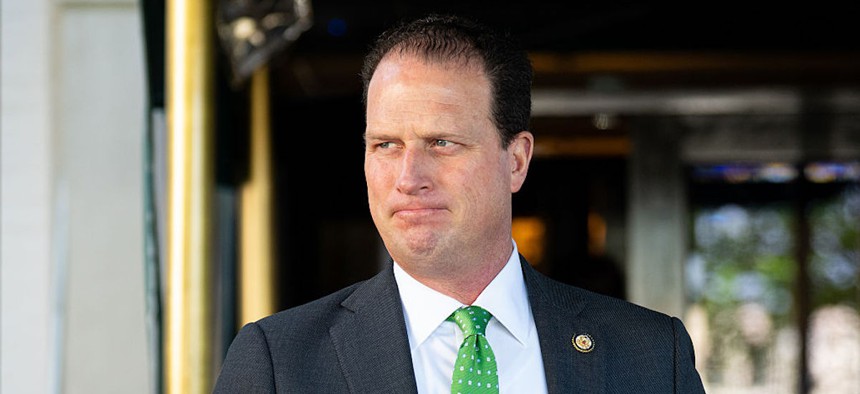
Rep. August Pfluger, R-Texas, leaves the House Republican Conference caucus meeting at the Capitol Hill Club in Washington on Wednesday, May 13, 2026. His bill seeking to seeks to clarify I&A’s role under the Homeland Security Act passed the House Homeland Security Committee on Thursday. Bill Clark/CQ-Roll Call, Inc via Getty Images



The measures aim to modernize terror alerts, expand local threat support and standardize training under the Office of Intelligence and Analysis, which the Trump administration is seeking to restructure.
The House Homeland Security Committee advanced a raft of bills on Thursday seeking to refine the Homeland Security Department’s Office of Intelligence and Analysis and improve its ability to defend against various threats targeting state, local, tribal and territorial communities.
The seven bipartisan bills mark Congress’ latest attempt to shore up the intelligence office after a year of workforce upheaval and longstanding bipartisan pressure for reforms tied to concerns over politicization and surveillance overreach.
A centerpiece measure led by Rep. August Pfluger, R-Texas — who chairs the panel’s counterterrorism and intelligence subcommittee — seeks to clarify I&A’s role under the Homeland Security Act by emphasizing the office’s responsibility to facilitate two-way threat intelligence sharing between federal authorities and state and local partners.
Other Democrat-led measures included efforts aimed at updating how DHS handles public threat warnings, shares intelligence and trains analysts. The proposals would push DHS to modernize the nation’s terrorism alert system, increase support for state and local officials facing potential foreign espionage risks and require more standardized training for intelligence personnel on analytic standards, privacy and civil liberties protections.
“It’s no secret that I&A has had challenges in the past. Concerns around mission overreach, political bias and other hurdles have hurt this agency's reputation,” Pfluger said during the committee markup of the measures. “Yet everyone here recognizes how important its mission is to securing the homeland.”
The Trump administration is seeking to combine I&A and the department’s Office of the Secretary and Executive Management, Management Directorate and Office of Situational Awareness into a single unit reporting to the DHS secretary. It’s not clear how these measures would run up against those efforts. The new structure would not affect its oversight under the Office of the Director of National Intelligence, an administration official previously told Nextgov/FCW.
I&A was slated for major workforce reductions in President Donald Trump’s second term, Nextgov/FCW first reported last July. Those plans, which would have only kept some 275 people at the office, drew major pushback from law enforcement organizations and Jewish groups that long relied on the agency to disseminate timely intelligence about threats that concern their communities.
The downsizing was put on hold just days later, but I&A reignited efforts soon after to shed its workforce more gradually. As of now, the office has around 550 full-time employees, according to a person familiar with the matter who requested anonymity to provide the figure. That number preserves more staff than the initial plans to cap the workforce at 275, but it is still half of the 1,000-person operation in place earlier last year.
The office falls within the purview of the Senate and House Intelligence committees, but its status as a DHS component also subjects it to oversight from the Homeland Security panels in both chambers of Congress.
In November, Nextgov/FCW reported that the House Intelligence Committee privately weighed a measure in the annual intelligence community authorization bill to significantly curtail the size and scope of I&A. The provision would have barred the office from gathering and analyzing intelligence, effectively turning I&A into a clearinghouse for intelligence findings produced elsewhere and stripping it of standard spy agency collection authorities.
The lesser-known intelligence office at DHS has faced controversy for its role in alleged unchecked domestic surveillance. During the 2020 racial justice protests, I&A analysts collected intelligence on journalists and demonstrators in Portland, Oregon, which sparked vast internal oversight and led to the removal of a top official.
A separate congressional probe after the January 6, 2021, riots at the U.S. Capitol found that I&A and the FBI received numerous tips about online posts threatening violence at the site of the day’s events, but that such intel was not analyzed and flagged to law enforcement.
The office was created as part of the formation of DHS after the Sept. 11 terrorist attacks to coordinate intelligence on homeland threats and expand information sharing with state and local authorities.