
Gabbard’s expanded role in election security draws scrutiny
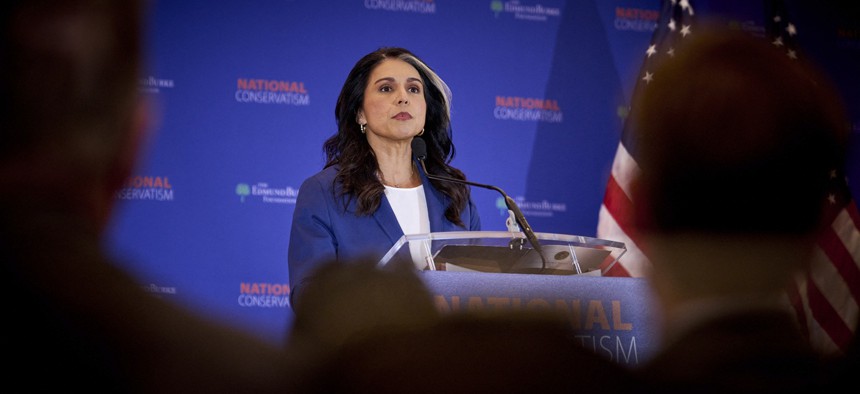
Director of National Intelligence Tulsi Gabbard speaks at the National Conservatism Conference in Washington D.C., Sept. 3, 2025. DOMINIC GWINN/Middle East Images/AFP via Getty Images





Since the start of the year, the White House chief of staff and DHS secretary have met multiple times to discuss election security, and DNI Tulsi Gabbard has been present in at least one of those meetings, according to a U.S. official.
Director of National Intelligence Tulsi Gabbard has become increasingly involved in election security and integrity efforts, drawing scrutiny over whether the role aligns with her office’s mandate and concerns that it could undermine public confidence in future elections.
The concerns follow a series of election-related actions by Gabbard, including her recent appearance during an FBI raid of a Fulton County, Georgia elections office that was at the center of President Donald Trump’s false claims of election fraud in 2020. Her team seized voting machines in Puerto Rico last year, per Reuters reporting, and has since said the systems contain cybersecurity vulnerabilities.
Gabbard’s agency is formally tasked with addressing foreign interference in U.S. elections, prompting questions about its expanding involvement in domestic election matters. The intelligence agencies overseen by ODNI are similarly focused on foreign threats and are generally restricted from conducting spying activities inside the United States.
“It’s highly unusual for the Director of National Intelligence to be involved in election issues,” Samantha Tarazi, CEO of Voting Rights Lab, said in an email. “The U.S. Constitution is clear that determining how our elections work is left to the states and Congress, not the federal executive. As neither the states nor Congress seem to have authorized the DNI’s actions here, the constitutionality of those actions is highly questionable and deeply concerning.”
Gabbard’s work has spanned across multiple government agencies and involves several officials and advisors. Since the beginning of this year, White House Chief of Staff Susie Wiles and DHS Secretary Kristi Noem have met multiple times to discuss election security topics, according to a U.S. official familiar with the matter. Gabbard has been present in at least one of those meetings, added the official, who spoke on the condition of anonymity to provide details about the efforts.
Those meetings centered on the idea that the American public has lost confidence in the security of national elections and on exploring ways to restore trust in the process, the official said.
Kurt Olsen, a lawyer who claimed the 2020 election was stolen and later joined the Trump administration as a special government employee, has also been involved in efforts alongside Cleta Mitchell, a Republican elections activist and attorney, the official added. Mitchell and Olsen’s involvement with Gabbard’s efforts was first reported by the Wall Street Journal.
Gabbard’s office has defended her work, saying the Office of the Director of National Intelligence has a “vital role” in protecting critical infrastructure and analyzing intelligence related to election security.
“President Trump’s directive to secure our elections was clear, and DNI Gabbard has and will proudly continue to take actions within her authorities, alongside our interagency partners, including the FBI, to support ensuring the integrity of our elections,” an ODNI spokesperson said.
ODNI has also confirmed the seizures in Puerto Rico. A person familiar with Gabbard’s work told Politico that the Puerto Rico seizures were part of a broader effort to assess the susceptibility of U.S. voting machines to foreign hacking threats, and that a team of former intelligence community hackers was contracted to perform forensic work on the machines.
The efforts, broadly speaking, underscore Trump’s continued focus on challenging the 2020 election results, despite having made a comeback to the White House in 2024. His recent call to “nationalize” election processes also runs counter to constitutional standards that place states at the center of election administration.
ODNI’s involvement now further risks amplifying narratives around elections being insecure and unsafe, said Larry Norden, vice president of the Elections & Government program at the Brennan Center for Justice.
“It’s less about the past, more about the future and undermining confidence in elections,” he said. “The object is influence, intimidate and interfere, and the first step is influence with misinformation that can justify the intimidation and the interference. I think we have to accept that unfortunately, in recent federal elections, there’s been a lot of misinformation and lying about how they operate, about their security and integrity.”
In 2020, Trump lost in Georgia by roughly 11,000 votes, prompting him and supporters to press state officials to uncover supposed missing votes to change the outcome. A later hand-count of the ballots upheld the original results.
Virginia Senator Mark Warner, the top Democrat on the Senate Intelligence Committee, said in a Sunday “Face the Nation” interview the committee has “not been informed of any foreign nexus” that would explain Gabbard’s involvement in the FBI search of the Fulton County office.
What also remains unclear is how, if at all, the Cybersecurity and Infrastructure Security Agency is involved in the election integrity efforts. CISA is tasked, in part, with protecting physical election infrastructure, like tabulation devices, but the agency has broadly been scrutinized for its past efforts coordinating with social media companies to remove disinformation online. Much of CISA’s election security and disinformation work has also been slashed over the last year.
Cybersecurity specialists, election experts and former Trump administration national security officials have for years said there is no evidence of widespread fraud in the 2020 election.
ODNI, in the past, has held briefing calls to discuss intelligence assessments about foreign efforts to influence election outcomes on social media. It’s not clear the agency will continue those briefings in the leadup to this year’s November midterm elections.
“While the Trump administration is stuck in the past trying to relitigate 2020, what this is really about is determining the control and outcome of future elections,” Tarazi said. “Whether it is seizing ballots or demanding private voter data, President Trump is showing how he will react when he disagrees with election results this year.”