Insights
Securing public sector organizations against machine-speed attacks
<p></p> <p>The evolution of automated threats has pushed public sector cybersecurity across a significant threshold. The typical patch timelines that previously allowed agencies weeks to fix software flaws are growing increasingly narrow as machine-speed adversarial capabilities expand. Download to learn more.</p>

GovExec TV: Five Questions with Steven Rich
<p>In this episode of GovExec TV's Five Questions, Steven Rich, Vice President of State Sales for Granicus, speaks from the 2026 NASCIO Annual Conference about the core challenges state government leaders face today. Rich also delves into the transformative power of emerging technologies in helping state agencies improve constituent experiences and maintain public trust.</p>
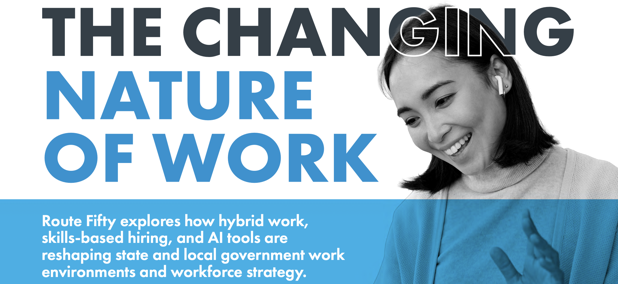
The Changing Nature of Work
<p>Route Fifty explores how hybrid work, skills-based hiring, and AI tools are reshaping state and local government work environments and workforce strategy.</p>
Cybersecurity in the agentic AI age: Balancing autonomy with human oversight
<p>On a daily basis, modern security operations centers (SOCs) face a deluge of incoming alerts, telemetry feeds, vulnerability reports and threat intelligence. As attack surfaces expand and federal workloads become increasingly distributed across different environments, agency security teams are at risk of being buried under data streams moving faster than they can analyze and evaluate.</p>
Managing and unifying AI across distributed environments
<p>Federal agencies generate and leverage data throughout highly distributed environments. From data centers to field offices to the edge, each environment operates under distinct connectivity, latency, power and operational constraints. To address these challenges, agencies must align workloads to the appropriate environments and unify distributed AI operations into one connected ecosystem. Shifting from hardware-centric planning toward a problem-first, workload-driven model enables agencies to optimize performance and deployment speed.</p>
Building digital resilience for the agentic era
<p>Government agencies face mounting pressure to keep mission critical systems secure, resilient and accessible as the technology environments supporting them grow more complex. However, the data agencies rely on to understand these ecosystems often remains fragmented across systems and teams, making it difficult to respond quickly to emerging issues and maintain a complete operational picture.</p> <p>"Building digital resilience for the agentic era" offers a comprehensive framework to tackle these challenges, helping agencies to function more efficiently without compromising visibility or control. Download now to learn more.</p>
Protecting government work as AI moves from answering to acting
<p>As government employees and AI agents gain access to sensitive information, agencies need to look beyond permissions to understand how that information is being used. Explore how context-aware security can help agencies identify risky activity, prevent data exposure and protect sensitive information without disrupting legitimate work.</p>
Why Secure Cloud Faxing Is the Final Frontier of Federal Digital Transformation and Legacy Decommissioning
<p data-pm-slice="1 1 []">Federal agencies face growing pressure to modernize outdated fax infrastructure while meeting evolving compliance and security requirements. With the CMS-0053-F implementation deadline approaching in 2028, discover why secure, FedRAMP-authorized cloud faxing could be critical to retiring legacy systems, reducing technical debt and accelerating digital transformation.</p>

Fortra’s Data Classification Suite Ultra Edition
<p>Highly sensitive information needs precise markings and labels that can be trusted. This solution brief explains how DCS Ultra Edition adds cryptographically signed trusted labels and portion marking for individual sections of documents and emails. Download it to explore capabilities designed for demanding government information-sharing environments.</p>

Defensive Cybersecurity for Federal Agencies (eBook)
<p>Federal security teams need to meet demanding requirements while helping the mission move forward. This eBook explores a policy-first approach across data classification, integrity and compliance monitoring, and secure email. Download it for federal use cases and examples of supporting collaboration across sensitive, classified, and isolated environments.</p>

Fortra Solutions for Government
<p>Your agency’s security priorities span data, systems, people, and partners. This datasheet maps Fortra’s government portfolio to those needs, including data protection, secure file transfer, vulnerability management, email security, and managed services. Download it to explore capabilities that support CUI protection, Zero Trust goals, and risk management efforts.</p>

Fortra Data Security for Government Missions
<p>How do you protect sensitive information as it moves among agencies, partners, and environments? Explore Fortra’s approach to discovering and classifying data, connecting it to protection policies, and supporting secure sharing. Download this overview to see how security can follow the information your mission depends on.</p>

Fortra Data Classification for Government Agencies
<p>PII and other sensitive information can be hard to track across documents, email, and devices. This datasheet explains how Fortra Data Classification uses labels and persistent metadata to inform downstream security tools. Download it to explore customizable markings, classification automation, and reporting that support your agency’s handling and compliance needs.</p>

10 Data Classification Mistakes to Avoid
<p>A classification tool alone will not make a data protection program succeed. This guide breaks down 10 common mistakes, from unclear governance and inconsistent classification to missing executive support and user education. Download it to spot gaps in your approach and build a stronger foundation for protecting sensitive information.</p>

The Definitive Guide to Data Classification
<p>Where should your data classification program begin? This guide explains the methods, common myths, and practical steps behind successful classification. Download it to learn how to prioritize sensitive information, compare approaches, build internal support, and give security tools the context they need to apply appropriate protections.</p>


Turning public-sector scale into smarter health care purchasing
By Dan Mendelson, CEO of Morgan Health

Data Center Security: Designing for Containment Before You Need It
<p>Modern data centers are no longer purely IT environments. Behind the racks of servers and networking equipment is an operational technology ecosystem responsible for keeping the facility running: power distribution, generators, UPS systems, cooling, building-management systems, and physical security.</p>
