The Fed's 35-year open data bet is a model for the AI era
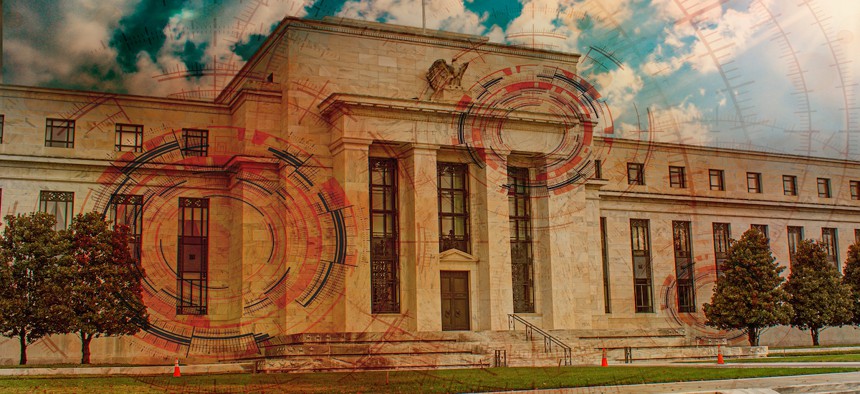
Douglas Rissing/Getty Images

COMMENTARY | Half of FRED's friends are now computers. The St. Louis Fed's response offers a playbook for every agency that publishes data.
Ask an economist, a reporter or a legislative staffer where a number came from and the answer often sounds like a colleague's name: FRED. Federal Reserve Governor Christopher Waller said the same is true around the world. Mention the St. Louis Fed overseas, he told a conference audience on Oct. 1, and people answer with one word: FRED.
I first met FRED long ago, as a novice user working for the leadership of the Missouri House. Even with little experience, I could quickly pull the information decisionmakers needed. Years later, as an economic researcher, I relied on FRED for far more sophisticated analytics. Few public tools serve both of those users well, and that range is a big part of what makes FRED a public good.
This month I was back in Missouri at the Federal Reserve Bank of St. Louis, moderating the closing panel of that conference on where FRED, the bank's Federal Reserve Economic Data service, goes next. Waller opened the day by calling FRED "the greatest public good" the Fed has ever created. After a day with the people who build and use it, I think he has a case.
These days FRED is making a lot of new friends and about half of them aren't human. For government executives, how FRED got here and how it is preparing for those new visitors, is the lesson worth studying.
A 35-year model
FRED's roots go back to 1961, when St. Louis Fed research director Homer Jones began mailing a typed weekly digest of economic data to policymakers, academics and journalists. In 1991, the bank put that data online through a computer bulletin board that users reached by dial-up modem. FRED became a website in 1995 with 865 data series and about 6,000 users a week.
Today FRED hosts more than 850,000 data series from governments and other sources around the world. It reached 18 million unique users in 2025, according to Waller.
The format changed with every new technology. The value proposition never did: one consistent, noncommercial place to find data from many producers, reproduced accurately and credited to the agencies that create it. That is what open data advocates have asked of the government for years, and what Congress wrote into the Foundations for Evidence-Based Policymaking Act of 2018 through the OPEN Government Data Act. FRED was delivering on that vision decades before the law passed.
Open data is not free
FRED did not grow from 6,000 weekly users to 18 million annual users by accident. Three ingredients made it work, and every agency leader should recognize them.
Sustained investment. Each leap, from mailed digests to dial-up to the web, required someone to fund staff and infrastructure ahead of demand. That pressure is now accelerating. Waller reported that FRED traffic is growing about 150% a year, driven mostly by AI agents and bots. Serving that load reliably costs real money, and agencies whose data draws similar attention will face the same bill.
Listening to users. The St. Louis Fed filled a room with the people who produce and depend on its data: officials from the U.S. Bureau of Economic Analysis and the U.S. Census Bureau, economists from Amazon, FedEx, Ramp, Indeed and Visa, journalists from The Economist, The Wall Street Journal and Bloomberg TV, and researchers from Kalshi and the World Bank. Keith Taylor, who leads the bank's research information services, closed the day by inviting participants to submit interest in the new FRED Advisory Board to keep those users involved. He was also candid that his team is better at saying "trust us" than at showing the work behind that claim. Leaders willing to say that out loud are usually the ones who fix it.
Leadership. Waller credited the bank's leaders for keeping their eyes on what FRED could become, and he championed FRED himself as the bank's director of research. Leadership also showed up in a decision he announced at the conference: users looking for certain data published by the Federal Reserve Board of Governors will soon be routed to FRED. Consolidating access on a proven, trusted platform is a choice leaders have to make on purpose.
The next generation of open data
The most striking number of the day: about half of visits to FRED now come from AI agents retrieving data, Waller said. The data suggests we’re seeing a seismic shift in how people consume information that originates on a portal like FRED. In catering to their users, public agencies responsible for making data open and usable have a different primary audience now. A website designed for human eyes doesn't automatically work for software that reads, summarizes and repackages data for someone else.
The St. Louis Fed's answer is the FRED MCP Connector, built on the Model Context Protocol, an open standard for linking AI systems to outside data. It lets people find and retrieve FRED data through the AI agent of their choice rather than a single tool chosen for them. FRED staff are also building guidance to help agents work with economic data accurately, and linking FRED to ALFRED — its archive of data as first reported — and to FRASER — the Fed's library of historical documents — so AI answers can show how numbers were revised and the context behind them.
Being AI-forward here is not about chasing hype. Waller was candid that AI can hallucinate, misread data and confuse correlation with causation, and that FRED's managers can't always tell whether agents credit the original source. The connector is a bet that the best defense is to make the trusted path the easiest path. On the closing panel I moderated, we kept returning to a simple test: is access actually improving, meaning better-informed users, not just more traffic? When half the visitors are machines, that question gets harder to answer and more important to ask.
Others in the room are learning the same lesson. Ara Kharazian of Ramp, whose AI Index went live on FRED the day before the conference, described first publishing the company's AI Index as an embedded chart, then discovering that AI tools couldn't read it. Ramp rebuilt the page so agents could. Aidan Smith of the Census Bureau described statistical agencies working to make their websites ready for AI so agents pick up methodology and limitations along with the numbers. And FedEx's Arvind Rajagopalan argued that generative AI raises the stakes on the unglamorous fundamentals: metadata, quality and freshness.
What federal leaders should do now
Every agency that publishes data is about to face FRED's situation, if it hasn't already. Three steps would help.
First, treat AI agents as an audience. Test whether common AI tools can find your data, read it correctly and credit your agency as the source. If they can't, fix the publishing, not the user.
Second, fund the fundamentals. Documentation, metadata, machine-readable formats and Chief Data Officers with real resources are not overhead. They are what keeps data trustworthy when no human is checking the output.
Third, build feedback loops that include the developers and AI companies whose tools now sit between agencies and the public. FRED's conference is one model. Agencies don't need a ballroom to start; they need a habit of asking.
The Data Foundation and its partners are developing a National Data Strategy that treats public data as national infrastructure, starting from the reality that generative AI makes data both more valuable and more sensitive. FRED's experience belongs at the center of that conversation.
In the early days of FRED, the team mailed typed pages. Today a student, a small-business owner or a congressional staffer can just ask an AI tool a question and get an answer drawn from FRED. The delivery method has changed again and again. But the mission has not: trusted data, open to everyone, serving the American people is key. And that’s why our leaders must keep investing resources in a national data ecosystem that serves us all.
Nick Hart is president and CEO of the Data Foundation, an independent, nonpartisan think tank in Washington, D.C. He moderated the "Accessible for All" panel at the Federal Reserve Bank of St. Louis FREDcon conference on Oct. 1, 2026.