
The man who built the web wants to fix it
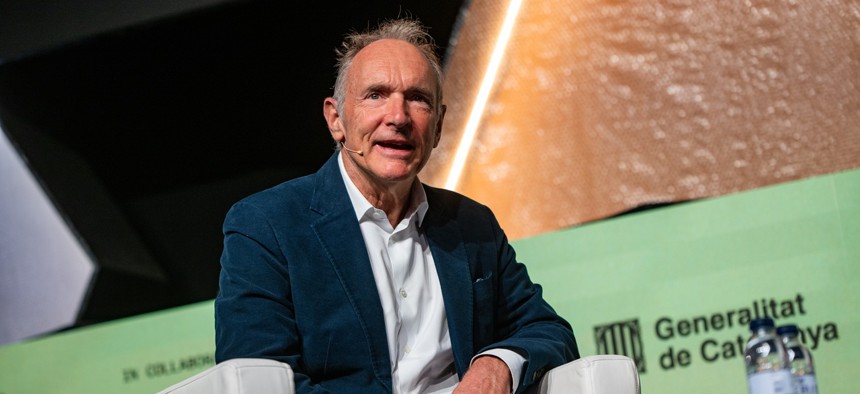
The inventor of the World Wide Web, Tim-Berners Lee, during a conference at the Talent Arena, at the Fira de Barcelona, on 3 March 2026, in Barcelona, Catalonia, Spain. Lorena Sopena/Europa Press via Getty Images





Addictive algorithms are a design choice, according to Tim Berners-Lee.
Decades after inventing the web, Tim Berners-Lee is still defending it.
This time, he's not talking about browsers or bandwidth but about business models. Onstage in Barcelona at Talent Arena on March 3, Berners-Lee said many of today’s platforms are designed to maximize engagement and what drives engagement is not measured debate but outrage, fear and extreme content.
"When you put in the addictive algorithm, you do it deliberately," he said, pushing back on the idea that these systems are inevitable.
Berners-Lee conceived the web in 1989 while working at CERN, the European Organization for Nuclear Research, to help scientists share information across institutions. The idea was simple. At CERN, knowledge moved through hallway conversations and coffee breaks.
"One of the things I wanted to do was to be able to replace the coffee place," he said.
The web scaled that exchange to the world. It was decentralized by design. Anyone could link to anything, and no central authority controlled it. In 1993, CERN made the core technology royalty free, clearing the way for global adoption. Competitors agreed on shared standards at the infrastructure layer, even as they fought for dominance.
Netscape and Microsoft were battling for browser dominance, but both knew agreeing on shared standards would make the web bigger for everyone.
"You've got these two forces and you move forward," he said.
Three decades later, Berners-Lee has no illusions about what followed.
Most of the web still works as intended. Open standards let browsers and websites communicate. Information moves across borders and innovation doesn’t require permission from a single gatekeeper.
“Most of the web, I'm very positive about,” he said. “There are some bits I'm disappointed in.”
Social networks turned into social media. Users turned into broadcasters. Platforms shifted from connecting small groups of friends to curating feeds for billions. The goal became keeping users on the platform as long as possible.
Developers and companies choose what to optimize for, Berners-Lee said. They can build systems that encourage healthy interaction and exposure to different perspectives or systems that reward compulsion. If an algorithm boosts harmful content because it drives clicks, responsibility doesn’t vanish into technical complexity. Systems are designed by people so they can be redesigned.
That belief drives his current work. Through a project called Solid, Berners-Lee is separating personal data from platforms. Today, most user data lives in corporate clouds run by businesses. People may technically own their data, but it sits inside company-controlled systems.
In Solid, personal data sits in individual online stores. Apps ask for access to specific information and users can grant or revoke that access at any time.
Berners-Lee is already building on that model. Charlie is an AI assistant that pulls from a user’s Solid data store, not a corporate database. A general AI system starts blind, trained on the open web and knowing nothing specific about you. Charlie has permission to use your data. Ask what running shoes to buy and it knows you are training for a half marathon, how many miles you run each week and whether you train on roads or trails.
"Claude doesn't understand anything about you, but Charlie does," Berners-Lee said.
Some governments, including the Flemish government in Belgium, are testing similar approaches that give citizens controlled digital storage environments for public services. He sees that as proof the web’s architecture can still evolve.
The web was designed, which means it can be redesigned, Berners-Lee said. That work belongs to the developers, product teams and founders building what comes next. He left the crowd with a clear directive:
"We should imagine a better world,” he said. “Imagine apps which are collaborative, which are creative, which are compassionate. Imagine this world — and do whatever you can to get towards that world."