
CMS pitches new contractor operating model for ‘detect and prevent’ fraud strategy
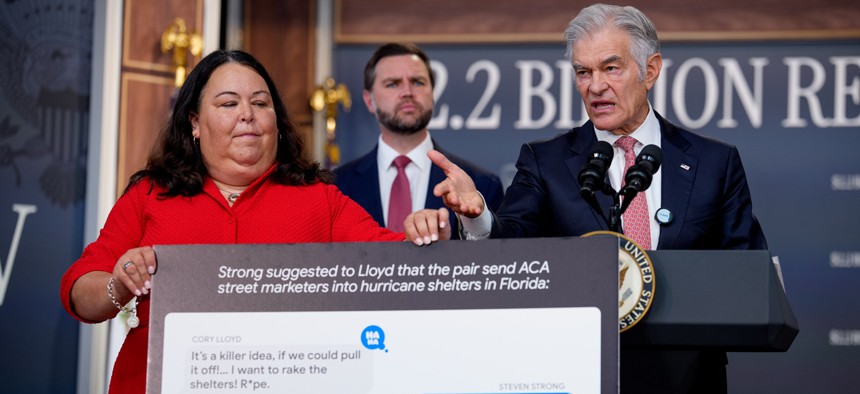
Vice President J.D. Vance (C) appears onstage as Deputy Administrator & Chief Operating Officer Kimberly Brandt (L) holds up a poster depicting a text conversation with Cory Lloyd, convicted of Affordable Care Act fraud, as Administrator for the Centers for Medicare & Medicaid Services Dr. Mehmet Oz (R), speaks during a news conference on fraud at the Eisenhower Executive Office Building on the White House Campus on September 22, 2026 in Washington, DC. Andrew Harnik/Getty Images






The proposal builds on the Trump administration’s multi-faceted effort to curtail fraud, waste and abuse in federal health programs.
The Centers for Medicare and Medicaid Services is exploring a new contract operating model and technologies so that the agency can more effectively prevent fraud, instead of chasing after money already in the hands of bad actors, according to documents posted on SAM.gov Monday.
CMS has traditionally contracted with private companies to boost its investigative capabilities and support administrative actions, such as imposing payment suspensions, according to the listing. But under a draft operating model, CMS wants to take a greater role in leading the development, prioritization and direction of those investigations, the website adds.
The old model “worked in the past but new technology and new techniques mean it is time to see if it still works as well,” Kimberly Brandt, a CMS Deputy Administrator, posted on LinkedIn.
Under the draft model, CMS would assign fraud investigations to contractors whose primary role is to develop the investigation and administrative actions under the agency’s oversight, according to a draft Statement of Objectives posted on SAM.gov.
At CMS’ direction, contractors could review claims, conduct provider interviews and coordinate with other program integrity stakeholders while documenting those investigative methods in a central CMS-designated system, the document continues.
The model also gives contractors the flexibility to develop potential fraud leads from authorized data sources, pending CMS approval and the company’s capacity.
A request for information asks contractors a series of questions about how private companies can best fulfill the proposed operating model detailed in the Statement of Objectives.
For example, the agency asks about the strengths and weaknesses of centralizing “compliance-related tasks” and provider site verifications. The agency also asks if it should contract with specialty companies for different provider types and if investigations involving private Medicare plans should be integrated with ones involving traditional Medicare.
The RFI includes a question about which data sources, analytics, artificial intelligence, SQL methods and other technologies CMS should use to develop fraud leads and investigations.
The RFI — which closes Nov. 4 at 11 a.m. ET — is only for informational purposes and will not lead to awards, according to the SAM.gov listing.
The questions are meant to “help us identify how to ensure our contracts with [third-party] entities helps us stop paying and chasing and instead detect and prevent,” Brandt wrote.
CMS stood up a Fraud Defense Operations Center in March 2025 to prevent fraud in federal health programs by reviewing claims in real-time, Brandt previously told Nextgov/FCW. The center has stopped nearly $2.5 billion in potentially fraudulent Medicare payments and taken action on just under 800 providers, Brandt recently said.
CMS is asking state medical boards for a point of contact the agency could work with to strengthen fraud-related data sharing, according to a video Administrator Mehmet Oz posted on social media yesterday.
But using new technologies is only part of the CMS strategy to curtail fraud, waste and abuse.
Brandt recently said she is urging congressional offices to give CMS the ability to occasionally stop providers and payers from enrolling in federal health programs.
And earlier this year, CMS published a “CRUSH” request for information seeking public comment on fraud-busting regulatory changes the agency could make to Medicare, Medicaid and other federal health programs.
The health sector is still waiting for those longer-term policy shifts, Kristen O’Brien, a healthcare policy and regulatory attorney at Holland & Knight, told Nextgov/FCW.
“While we wait for the next regulatory push on CRUSH, HHS is soliciting the public on what can be done today to leverage technology to crush fraud and abuse and save taxpayer money,” O’Brien said of the RFI released Monday.