
Defense prepares response to massive earthquake in Japan





 By
Bob Brewin
By
Bob Brewin
High-capacity undersea cable used by military was severed; impact on operations is unclear.
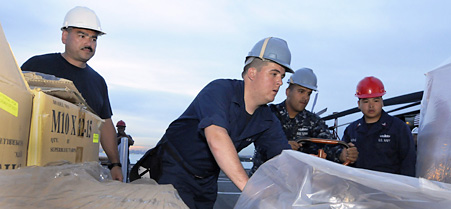 Sailors aboard the USS Blue Ridge prepare supplies to support relief operations in Japan.
U.S. military forces reacted quickly after a powerful earthquake and tsunami struck Japan on Friday. The Air Force flew emergency coolant to a damaged nuclear reactor and the Navy's 7th Fleet began moving ships to support relief operations there.
Secretary of State Hillary Clinton told attendees at a meeting of President Obama's Export Council that a Japanese nuclear power plant "came under a lot of stress as a result of the quake and did not have enough coolant." The Air Force, she said, made an emergency delivery of coolant to the plant.
The New York Times reported that Tokyo Electric Power had shutdown its plant in Fukishima, a two-hour drive north of the city, and declared an atomic power emergency after a mechanical failure in the cooling system.
Navy Cmdr. Jeff Davis, a spokesman for the 7th Fleet, said in an e-mail from the USS Blue Ridge that the command has directed all helicopter-capable ships in the fleet to be ready to sail to Japan in the next 24 hours to aid in relief operations. The Blue Ridge , the 7th Fleet command ship, was docked in Singapore when Davis sent his message.
Davis, said the USS Essex , a helicopter carrier currently in Malaysia, will sail for Japan tomorrow and added the USS Tortuga , a landing ship dock, left Sasebo, Japan, on Friday to pick up Air Force MH-53 helicopters based in Korea.
The USS Ronald Reagan carrier strike group, currently operating in the Western Pacific, was directed to proceed at the best safe speed to the main Japanese island of Honshu, the epicenter of the earthquake, with arrival expected in 36 hours, Davis said. The 7th Fleet also redirected two other dock landing ships to Japan -- the USS Harpers Ferry and USS Germantown , Davis said.
The Blue Ridge will depart for Japan tomorrow after loading humanitarian kits that include water, blankets, tarps, surgical masks, body bags, water purification tablets, and other supplies, Davis said. It is expected to arrive in six days.
Lt. Cmdr. Bill Clinton, a spokesman for the U.S. Pacific Command, said most U.S. military bases in Japan had "no significant damage" from the earthquake. Davis said the headquarters of the Navy's Maritime Patrol and Reconnaissance Force in Misawa, located at the northern tip of Honshu, lost electric power and was operating with generators.
Command-and-control functions for the patrol force have been shifted to installations in Atsugi, south of Tokyo, and Kadena, on the island of Okinawa.
The quake also cut a high-capacity undersea cable circuit from Afghanistan, which the Defense Department uses at its connection point with landlines in Misawa, Nextgov has learned. The quake severed the connection between the underseas cable and a land circuit KDDI, a Japanese telecommunications company.
Japan's Ministry of Internal Affairs reported the earthquake knocked out 20 million phone lines operated by KDDI, along with submarine cables. Laura Williams, a spokeswoman for the Defense Information Systems Agency, which operates the military global network, declined for national security reasons to comment on the status of its circuits in Japan and elsewhere in the Pacific.
Pacific Gas and Electric, which operates a nuclear power plant near the shoreline of San Luis Obispo, Calif., issued a precautionary " notice of unusual event " after receiving a tsunami warning from the West California Emergency Management Agency.
Gregory Jaczko, chairman of the Nuclear Regulatory Commission, said, "The NRC is closely monitoring this situation as it unfolds with respect to nuclear facilities within the United States." NRC also said it is monitoring the San Onofre nuclear power plant, located on the shoreline six miles south of San Clemente, Calif.
NRC said in a statement that "Nuclear power plants are built to withstand environmental hazards, including earthquakes and tsunamis. Even those plants that are located outside of areas with extensive seismic activity are designed for safety in the event of such a natural disaster."
Editor's note: The Pacific Tsunami Warning Center estimated the earthquake's magnitude at 9.1, the measurement cited in this story originally. The U.S. Geological Survey estimated the earthquake's magnitude was 9.0.
NEXT STORY: Reality Check