
General envisions every soldier equipped with a smart phone





 By
Bob Brewin
By
Bob Brewin
Army vice chief of staff wants to use technology to help manage behavioral health problems.
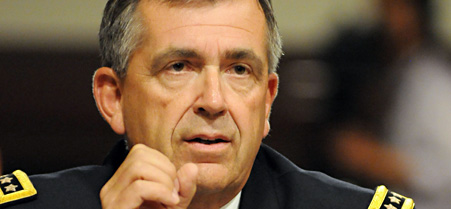 Gen. Peter Chiarelli notes the phones could connect troops directly with mental health professionals and counselors.
Gen. Peter Chiarelli, the Army's vice chief of staff, wields his smart phone with the technological savvy of soldiers far younger during an interview, and envisions a not-so-distant future where the service issues every troop a handheld gadget to do anything from sending e-mail to controlling robots on the battlefield.
This marks a high-level endorsement of ongoing field tests of smart phones in a tactical environment at Fort Bliss, Texas, and White Sands Missile Range, N.M., as well as the Apps for the Army project that the service's chief information officer, Lt. Gen. Jeffrey Sorenson, backs.
Chiarelli told Nextgov the utility and economics of smart phones and related gadgets such as small tablet computers argue for their adoption Armywide. It's easy to write applications for them, most young soldiers already own a smart phone, and if the service bought a phone for all 1.4 million of its soldiers, then it probably could get a substantial discount from retail prices, he said.
While he declined to speculate on dollar figures, Chiarelli noted advances in technology and economies of scale already have driven down prices, adding his first smart phone cost $600 and his latest phone -- the fourth he has purchased -- cost $200 and does a lot more.
The vice chief of staff, who spearheaded the Army task force on suicide and behavioral health problems, became impassioned when talking about using smart phones to help the service intervene before a soldier has a meltdown. Chiarelli's task force this July delivered a grim report on widespread mental health problems, as well as alcohol and drug abuse in the service.
The National Center for Telehealth and Technology at Joint Base Lewis-McChord, Wash., released an application Monday to help soldiers track their post-deployment emotional health. Chiarelli sees the application as the first step in using smart phone technology to help manage a range of behavioral problems soldiers experience after combat tours.
He said he would like to harness the power of smart phones to connect soldiers directly with mental health professionals and counselors via text messaging and built-in cameras. Soldiers in treatment for conditions such as post-traumatic stress (Chiarelli said he does not add the word "disorder" because stress in reaction to combat is a real injury, not a disorder) and traumatic brain injury could use text messages to consult with therapists on a daily basis.
If a therapist decided a soldier needed face-to-face counseling, a key component of mental health treatment, then both could fire up an application -- for example, FaceTime -- for a real-time video chat session, according to Chiarelli.
The Army should turn to technology to connect soldiers with mental health professionals, because it has a severe shortage of counselors, Chiarelli said. The smart phone projects have just entered the pilot phase, he said.
Chiarelli also said he wants to start a virtual behavioral health program with the Veterans Affairs Department "as soon as possible" to compensate for the shortage of Army mental health professionals, and he already has discussed the project with VA Secretary Eric Shinseki.
For example, the Dallas VA hospital has about 100 mental health professionals, and Chiarelli wants to enlist them to conduct evaluations of soldiers at nearby Fort Hood before they return to combat. He said he would like to set up 20 to 30 computers at Fort Hood to connect soldiers with clinicians for sessions conducted over a high-resolution videoconferencing link.
This would help the Army solve its shortage of counselors and identify potential high-risk behavior, all while using technology young soldiers are comfortable with. "These young kids would rather [talk to a counselor] over the Internet than in person," Chiarelli said.
NEXT STORY: Electronic Records Cut Cardiac Risk