
CMS hopes to quadruple provider suspensions over next six months, official says
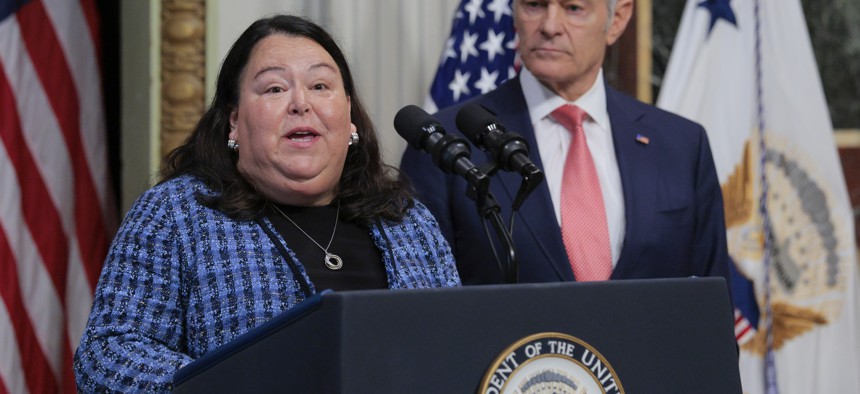
Deputy CMS Administrator Kim Brandt speaks during a press conference on the Trump administration's anti-fraud initiatives at the Eisenhower Executive Office Building on May 13, 2026 in Washington, DC. Chip Somodevilla/Getty Images





A new exclusion authority is the Trump administration’s latest step in a technology-enabled drive to restrict fraud, waste and abuse.
SANTA FE, N.M. — The Centers for Medicare and Medicaid Services plans to expand provider suspensions and publish the results of a pilot testing whether artificial intelligence can prevent Medicaid fraud, a senior agency official said Thursday.
The two moves are the latest in the Trump administration’s technology-enabled drive to trim fraud, waste and abuse in federal health care programs. The push has helped yield $41.9 billion in savings for fiscal year 2025, or a 59% increase over the previous year, according to a slideshow CMS Deputy Administrator Kimberly Brandt presented at the ADAPT conference in Santa Fe, New Mexico.
In April 2026, CMS launched a “Medicaid War Room” to curtail fraud, waste and abuse. The CMS arm has stopped $342 million in improper payments as of Sept. 2026 and sent 124 notices of intent to exclude providers, according to the slideshow.
“My hope is that suspension number will quadruple over the course of the next six months,” following new exclusion authority granted by the Health and Human Services Department earlier this week, Brandt said.
With that power, CMS can kick providers out of Medicare, Medicaid, TRICARE and other federal health care programs. Brandt previously said she urged congressional offices to give CMS the exclusion authority.
Beyond CMS’ push to exclude certain providers, Brandt noted that the agency is piloting AI and machine learning to detect Medicaid fraud.
The pilots use AI to flag suspicious billing patterns — such as upcoding, phantom services and geographic anomalies — in near real-time before Medicaid payments are made, according to the slideshow. The pilots are also testing a shared platform where CMS, Medicaid Fraud Control Units, program integrity contractors, states and law enforcement work on high-risk cases together.
“If proven out, the goal is to scale this into a national, standardized, continuously improving platform that stops fraudulent Medicaid payments before they’re made,” the slideshow said.
Brandt said CMS will soon publish the results of an Indiana Medicaid fraud pilot the agency conducted with Oracle, and that it is also actively working with five other states on Medicaid pilots. But the agency is also using other technologies to further its mission to combat fraud, waste and abuse.
CMS is utilizing a “Netflix-type algorithm” that compares new providers and suppliers with ones the agency already has a relationship with, Brandt said. The technology allows CMS to put suspicious providers and suppliers on a watchlist for the first six months after they enter a federal health care program. The agency has cut about 67% of those providers and suppliers because they did not follow or comply with program rules, she said.
Earlier this week, the Trump administration announced it cut subsidies for 189,000 people on the Affordable Care Act exchanges after it found those same enrollees had duplicate health care coverage or were dead. The administration said it found some of the duplicate beneficiaries through periodic data matching of Medicaid and the Children’s Health Insurance Program.
Brandt added that the agency is “doing even more” analysis of the Social Security Administration’s Death Master File so as not to issue payments to dead people, though she did not elaborate on what the analysis was.
Even so, CMS’ use of technology to claw back fraud has not been perfect, Brandt acknowledged.
“There are a lot of things about WISeR that are not working,” Brandt said, referring to a controversial pilot of AI-supported prior authorizations of Medicare items and services that have a high risk for fraud.
Hospitals and Democratic lawmakers have criticized the six-year initiative for delaying and denying seniors’ access to care since it launched at the beginning of the year. The House Ways and Means Committee advanced a provision to end the WISeR program in June, while the Senate has rejected efforts to stop it.
“Especially because of the congressional scrutiny on [the WISeR program, CMS Innovation Center staff] are committed to trying to get that right and get it better,” Brandt said.
Among the lessons CMS has learned from the WISeR model are that technology requires continuous oversight, human clinical review is essential and provider feedback is an important monitoring signal, according to the slideshow.
NEXT STORY: Everybody hated Socrates