
sponsor content What's this?
Innovation Spotlight: Cloud-Enabled Computing Aids ‘Disconnected Operations’
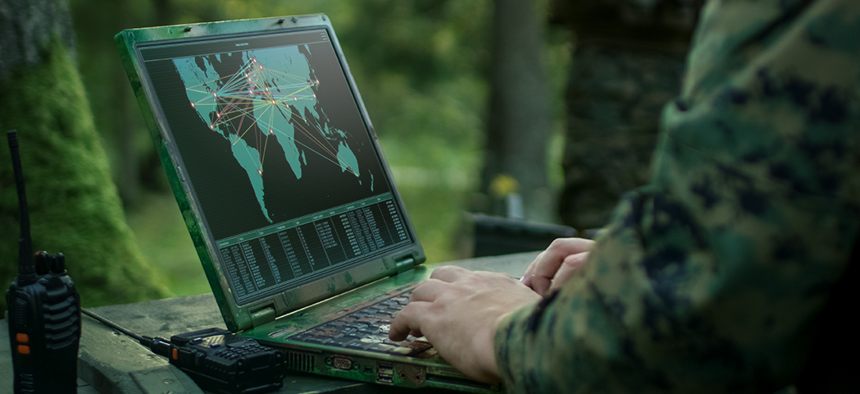



Military organizations have been increasingly forced to prepare for operations in delayed/disconnected, intermittently-connected, low-bandwidth, or DIL, environments, a situation where network connectivity is shaky and warfighters and military support personnel can’t easily send and receive information to their enterprise systems.
When commanders and soldiers can’t easily exchange information in the field it erodes the team’s ability to complete its mission. Military officials are especially concerned about communications loss as a result of cyberattacks. They also can’t completely rely on connectivity in the remote regions where the military operates. Naval vessels at sea, for instance, may lose connectivity because of poor weather conditions, power outages, antiquated infrastructure, or lack of available redundant carrier networks.
“These obstacles also apply to bases located in the desert in the Middle East or even a remote location inside the United States,” said David Lincourt, defense and security solution expert at SAP.
Lincourt explained that there are five key characteristics and challenges to what he and his team at SAP simply call “disconnected operations” for short:
- The type of connectivity often varies by location or situation. At very remote locations like the desert, or fighting a wildfire, reliable data communications may simply not be available.
- Data transmission costs may be too high for limited budgets. Tight military budgets can make it impossible for certain organizations to afford bandwidth. This can happen when squadrons leave the base for a forward mission, or it can just be the reality that running enterprise applications over satellite communications costs too much for some military organizations to afford.
- Data transmission becomes degraded or not permitted for safety or operational reasons. Organizations may not want to run communications in certain areas because they could trigger an explosion or tip off the enemy to the group’s position.
- Transmission protocols restrict how data can get transmitted and stored. Certain military networks only allow very specific communications messages. For example, the protocols for encryption may not allow communications, or the network is simply not conducive to administrative communications for documents, spreadsheets, and graphics files.
- Enterprise systems are not available (planned or unplanned). In certain situations, networks are not available over weekends, but whether it’s for foreign or domestic operations, military teams need 24x7 connectivity. Emergency response teams don’t take days off if there’s an emergency over a weekend – same for military teams out in the field – they are always on and need constant connectivity.
What’s changed in the last 20 years?
Matthias Ledwon, industry executive advisor at SAP, said military organizations of two decades ago faced many of the same daily communications challenges when it comes to logistics processes, but for the most part, Enterprise Resource
Planning systems (ERP) for defense logistics were implemented under the assumption that connectivity was guaranteed.
“Fifteen or 20 years ago, a lot of organizations assumed that the connectivity would be there,” said Ledwon. “All the new web apps and central business systems accessible via satellite communication (SatCom) that people built back then would work great so long as the connectivity was guaranteed. But conflicts of the past decade have reminded military leaders that SatCom increases vulnerabilities. And the amount of data collected and transferred has grown rapidly, just think about IoT. So, we must expect that adversaries are trying to disrupt operations. Cyberattacks can happen anywhere, from overseas installations to operations in the United States.”
SAP’s Lincourt said military organizations are looking to integrate SAP’s cloud-based ERP system with “Cloud in a Box” technologies from the major cloud providers such as Amazon Web Services, Microsoft Azure and the Google Cloud Platform.
“These appliances sit on the edge of the network, they have enough compute and storage to run an enterprise system,” said Lincourt. “The form factor is also advantageous; they are getting smaller and smaller and more and more powerful. About the size of a carry-on bag. Depending on the needs of the team they can only bring the data that they need to effectively operate during the mission.”
Lincourt explained that by installing Cloud in a Box appliances at the edge on ships or at bases in remote locations, the military’s technical people can operate the way they would stateside, where all patches, configurations, backups, and management tasks are done centrally over a cloud-based interface. If connectivity gets disrupted for any reason, the teams can still work locally on ruggedized versions of smartphones and laptops and then update when connectivity gets restored. Lincourt adds that if ruggedized devices are not available, the Cloud in a Box appliances, field unit smartphones, and laptops can get stored in specialized cases to make them rugged.
“What’s important here is that we’re bringing cloud-based enterprise computing to remote locations,” Lincourt said. “People work the same way they do back home.”
“During the conflicts of the past 20 years,” said Ledwon, “soldiers deployed off-base would have to take pen-and-paper with them in the field, repair a tank or truck, then go back to the base, enter the data over satellite communication on central systems. Today, they may still lack connectivity in the field, but they could use modern handheld devices and have a mobile version of SAP’s ERP system to enter and analyze data on the battlefield.”
“The key to this is putting modern decision support systems into the hands of military commanders,” Ledwon said. “They need accurate data and visibility. They need to know where the forces are, where the weapons are stored, where the supplies are stored, and where the spare parts are kept. If a unit can’t get supply orders replenished in time, things won’t work. We’ve all been seeing how a breakdown in the supply chain has impacted all of us here. It also plays a crucial role in military operations.”
Ledwon said military organizations have three choices moving forward: run without communications — not a good choice for military leaders working in high-pressure situations; go back to on-premises operations — an expensive and impractical choice because it doesn’t give the team the benefits of modern cloud environments; or go with the ERP in the Cloud in a Box and other solutions for disconnected operations.
Today, Lincourt and Ledwon say, integrated SAP ERP systems run on Naval vessels around the world and are supporting aircraft on missions, away from their regular airfield. 5G communication will allow defense forces to bring these modern systems further to the tactical edge.
“This makes a world of difference, especially for our sailors out at sea,” Lincourt said. “It’s really not realistic to expect that we can do true online processing of administrative data via satellite communications at sea, there’s too much latency. The Cloud in a Box with SAP’s ERP lets the military modernize. They get an experience that’s consistent with the way they would do things at home in a cloud-based environment. For the system administrators, all the managing, updating, and provisioning gets done in the cloud. So, there’s less latency and errors for the user and lower maintenance costs for the computing operation.”
Defense Forces like the DoD value solutions to continue logistics operations when the communications to the backend system fails while at the same time allows them to take advantage of cloud computing.
Learn more at sap.com.
This content is made possible by our sponsor SAP; it is not written by and does not necessarily reflect the views of FCW’s editorial staff.