
sponsor content What's this?
KVM Is No Longer Just a Data Center Tool
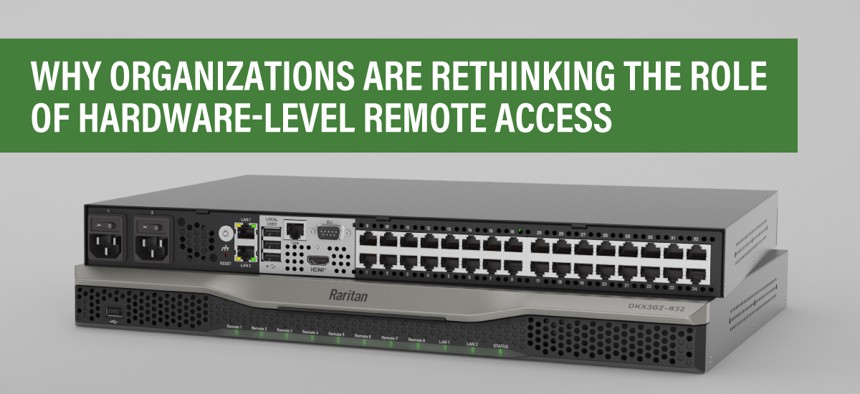



For decades, KVM occupied a well-defined role within IT operations. When a server became unresponsive, an operating system failed, or an administrator needed access below the software layer; KVM provided a reliable path to recovery. It was an essential technology, but one that was often viewed through a relatively narrow lens: a tool for troubleshooting and out-of-band management.
While those use cases remain important, they no longer represent the full story. As organizations expand beyond traditional data center environments and adopt new operational models, the role of hardware-level remote access is evolving. Increasingly, KVM is being deployed not simply as a contingency technology, but as part of a broader strategy to improve operational efficiency, centralize expertise, and support distributed infrastructure.
Infrastructure Is No Longer Confined to the Data Center
The modern infrastructure landscape extends far beyond rows of servers housed in centralized facilities. Manufacturing plants, healthcare systems, broadcast environments, and enterprise campuses all depend on technology that must be monitored, managed, and maintained. In many cases, these environments contain specialized equipment that cannot be supported easily through conventional software-based management tools alone.
At the same time, organizations are under pressure to do more with fewer resources. Specialized expertise is often concentrated within a relatively small number of teams that may be responsible for supporting systems across multiple facilities, regions, or business units. The challenge is no longer simply managing technology. It is extending expertise across increasingly distributed environments without sacrificing responsiveness or operational continuity.
As a result, organizations are reevaluating the technologies and processes they use to support critical infrastructure. Remote access remains central to that discussion, but many are discovering that software-based tools do not address every operational requirement.
Why Hardware-Level Access Still Matters
Software-based remote access technologies have transformed infrastructure management and remain indispensable in modern environments. However, many operational systems continue to present challenges that software tools alone cannot fully address. Legacy platforms, embedded technologies, proprietary applications, and highly specialized equipment often require a different approach to visibility and control.
Even in traditional IT environments, software-based access depends on a functioning operating system, active network services, and properly configured software agents. When one of those elements becomes unavailable, access can disappear at precisely the moment support teams need it most. Hardware-level access provides an additional layer of resiliency by operating independently of the software stack, enabling visibility and control during recovery scenarios as well as routine operational activities.
For many organizations, this capability is becoming increasingly valuable as infrastructure grows more complex and operational expectations continue to rise. Rather than replacing those software-based management tools, hardware-level access complements them by extending operational visibility into environments where traditional approaches may be limited.
From Recovery Tool to Operational Platform
Perhaps the most significant change is not technological, but operational. Organizations are increasingly viewing KVM as a platform that supports ongoing operations rather than solely a mechanism for responding to failures. This shift reflects a broader change in how infrastructure is managed and how technical expertise is deployed.
Healthcare providers use remote access technologies to support imaging systems and specialized clinical equipment. Manufacturers are leveraging centralized operations models to oversee production environments without requiring experts at every facility. Broadcast organizations rely on remote workflows that demand reliable, low-latency access to systems located across multiple sites. Enterprise facilities teams are using hardware-level access to support collaboration technologies and AV infrastructure distributed across campuses and offices.
While these environments differ significantly, the underlying objective is remarkably consistent. Organizations are seeking ways to centralize expertise while maintaining reliable access to distributed systems. KVM is increasingly helping them achieve that goal by providing a common operational layer that supports visibility, control, and responsiveness across a diverse range of environments.
Looking Ahead
Viewed together, these trends suggest that the future of KVM may have less to do with recovering failed systems and more to do with enabling modern operational models. As organizations continue to expand distributed infrastructure, pursue greater efficiency, and explore automation initiatives, hardware-level access is finding new relevance beyond its traditional role in the data center.
What was once considered a niche troubleshooting technology is increasingly becoming part of the operational foundation that supports resilient, scalable infrastructure. To learn more about this evolution and explore emerging use cases across multiple industries, download our white paper, Beyond the Data Center: Why KVM is Becoming a Strategic Platform in Modern Operational Environments.
This content is made possible by our sponsor Raritan. It is not written by and does not necessarily reflect the views of NextGov/FCW's editorial staff.
NEXT STORY: What Comes After Certification? The Shift to Compliant Security Operations.