
We Still Do Not Know If Voyager 1 Has Left the Solar System
NASA





The official position remains that the spacecraft has not yet crossed over into interstellar space
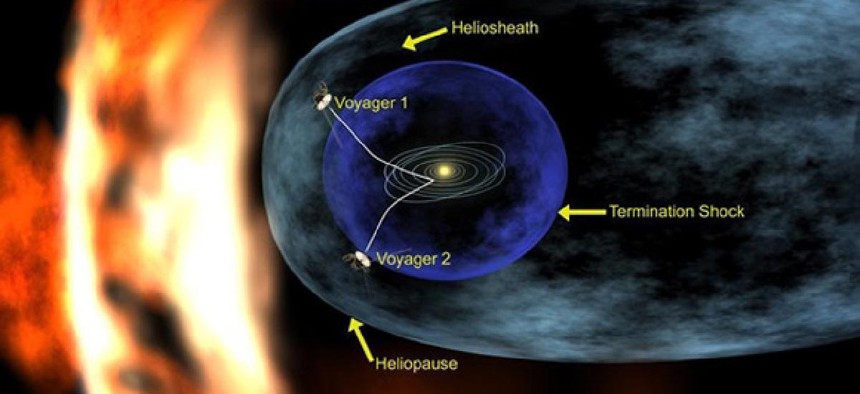
For 35 years, a spaceship built here on this planet has been flying away from our planet. And today, on this momentous day of March 20, 2013, the American Geophysical Union put out a press release announcing that *it* had finally happened: Voyager 1 had left the solar system, as indicated by "sudden changes in cosmic rays."
Could it really be?
Well, it could really be, but the official position of the Voyager team remains that Voyager 1 has not yet left the heliosphere, Donald Gurnett who has worked on Voyager since the 1970s, told me. Within a number of hours, AGU backtracked, releasing a correction minutes ago calling the location of Voyager 1 "a new region of space."
Why the confusion? The paper in question concludes that the intensities of anomalous cosmic rays (ACR) and galactic cosmic rays (GCR) shifted dramatically on August 25, 2012, and that these shifts "indicate that V1 has crossed a well-defined boundary for energetic particles at this time possibly related to the heliopause."