
How NASA Scientists Are Turning L.A. Into One Big Climate-Change Lab
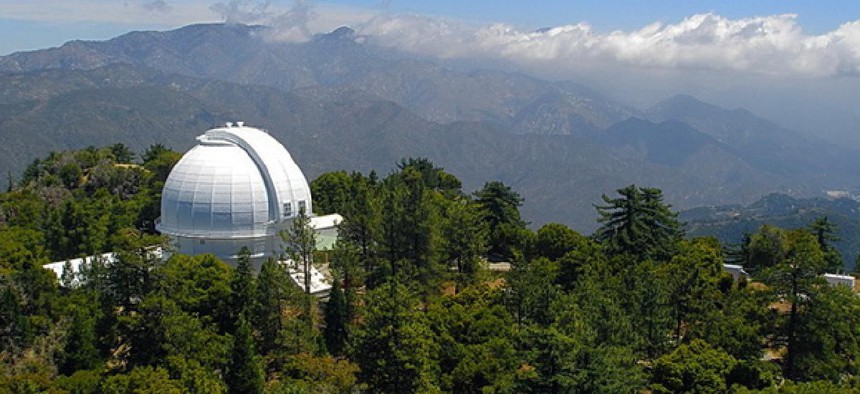
The Mount Wilson Observatory near Altadena, Calif. Flickr user Luke Bryant





Scientists have been probing the city's airspace for more than a year, as part of an interagency initiative called the Megacities Carbon Project.
Southern California’s Mount Wilson is a lonesome, hostile peak — prone to sudden rock falls, sometimes ringed by wildfire — that nevertheless has attracted some of the greatest minds in modern science.
George Ellery Hale, one of the godfathers of astrophysics, founded the Mount Wilson Observatory in 1904 and divined that sunspots were magnetic. His acolyte Edwin Hubble used a huge telescope, dragged up by mule train, to prove the universe was expanding. Even Albert Einstein made a pilgrimage in the 1930s to hobnob with the astronomers (and suffered a terrible hair day, a photo shows).
Today, Mount Wilson is the site of a more terrestrial but no less ambitious endeavor. Scientists from NASA’s Jet Propulsion Laboratory in Pasadena, Calif., and elsewhere are turning the entire Los Angeles metro region into a state-of-the-art climate laboratory. From the ridgeline, they deploy a mechanical lung that senses airborne chemicals and a unique sunbeam analyzer that scans the skies over the Los Angeles Basin. At a sister site at the California Institute of Technology (Caltech), researchers slice the clouds with a shimmering green laser, trap air samples in glass flasks, and stare at the sun with a massive mirrored contraption that looks like God’s own microscope.
These folks are the foot soldiers in an ambitious, interagency initiative called the Megacities Carbon Project. They’ve been probing L.A.’s airspace for more than a year, with the help of big-name sponsors like the National Institute of Standards and Technology, the Keck Institute for Space Studies, and the California Air Resources Board. If all goes well, by 2015 the Megacities crew and colleagues working on smaller cities such as Indianapolis and Boston will have pinned down a slippery piece of climate science: an empirical measurement of a city’s carbon footprint.